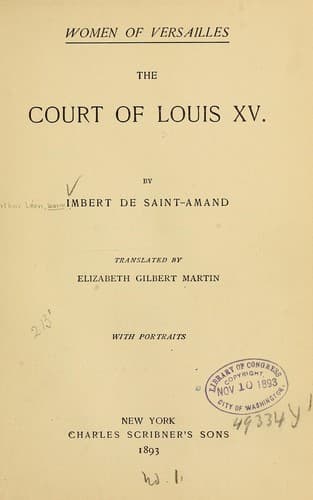
France -- Court and courtiers; France -- History -- Louis XV, 1715-1774
Madame de Pompadour was forty-two years old. Aged prematurely by
the unwholesome emotions of intrigue, vanity, and ambition, she was
suffering both in body and in mind. Incessant palpitation of the heart
disturbed her. Fever was her constant guest. On nearing the end of
her career she looked back sadly over the road she had traversed,
and comprehended at last the inanity of the things in which she had
vainly sought for happiness. But for a true repentance she lacked a
religious faith like that of Mademoiselle de La Vallière. In default of
faith, the Marquise had great courage. She strove energetically against
disease, but she remained worldly and theatrical even in suffering
and death. “She would no longer appear in Paris,” says M. Arsène
Houssaye; “at court she never showed herself except by lamplight, in
the apparel of a queen of Golconda, crowned with diamonds, wearing
twenty bracelets, and dragging after her an Indian robe embroidered
with gold and silver. It was always the divine Marquise of other days;
but presently, when one looked closely, one discovered that it was but
a pastel, still charming, but rubbed out here and there. It was at
the mouth that her beauty began to fade. She had early contracted the
habit of biting her lips, to conceal her emotions. By the time she was
thirty, her mouth had lost all its vivid freshness. It was necessary
to repaint it after every meal and every kiss!”[53] Her eyes had
retained all their brilliancy. But the rest of her person was plainly
aging. She tried in vain to conceal her excessive meagreness under the
skilful devices of the toilette. She was a woman stricken by death.
She fell ill at Choisy, and while there was still time she asked to
be taken back to Versailles in order to die as she had lived, amidst
the evidences of her power. Her friends had an instant of hope, for a
slight amelioration was produced. The poet Favart instantly produced
this stanza:--
“Le soleil est malade,
Et Pompadour aussi;
Ce n’est qu’une passade,
L’un et l’autre est guéri;
Le bon Dieu, qui seconde
Nos vœux et notre amour,
Pour le bonheur du monde,
Nous a rendu le jour
Avec Pompadour.”[54]
Palissot sent the following verses to the Marquise:--
“Vous êtes trop chère à la France,
Au dieu des arts et des amours,
Pour redouter du sort la fatale puissance.
Tous les dieux veillaient sur vos jours,
Tous étaient animés du zèle qui m’inspire;
En volant à votre secours
Ils ont affermi leur empire.”[55]
Madame de Pompadour did not allow herself to be deceived by these
fallacious hyperboles. All this mythology did not mislead her. She
understood very well that there was nothing in common between her and
the sun, and felt herself already invaded by the chilly shadows of
death.
Public-domain text, read in full here on John Shaqi.
Reviews
Reviews
No reviews yet
Be the first to share your thoughts on this work.
Elsewhere in the archive
Join the Discussion
Join the discussion
Sign in to leave a comment or review.
Sign InorCreate an account