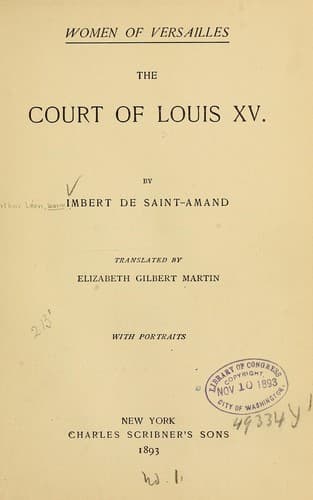
France -- Court and courtiers; France -- History -- Louis XV, 1715-1774
“It will come at the predestined day; it will come,” as Bossuet said,
“this last illness when, amidst an infinite number of friends, doctors,
and attendants, you will find yourself without assistance, more
forsaken, more abandoned, than the pauper dying on the straw without a
sheet for his burial! For of what avail are these friends in this fatal
malady? Only to afflict you by their presence; these doctors? only to
torment you; these attendants? only to run hither and thither about
your house with useless zeal. You need other friends, other servants;
these paupers whom you have despised are the only ones capable of
assisting you. Why did you not think in time of providing yourself
with such friends as would now hold out their arms to receive you into
everlasting tabernacles?”[56]
Even on her death-bed Madame de Pompadour, always the slave of the
man whose mistress she was called, feared the King more than God
himself. They say she sent to Louis XV. to ask if he desired her to go
to confession. The King replied affirmatively. A priest from Paris,
the curé of the Madeleine, administered the last sacraments to the
dying woman. When he was about to withdraw, it is pretended that she
retained him with a last smile, and said: “One moment, Monsieur the
Curé, we will go away together.” A few minutes before she had caused
her will to be read to her, which commenced thus: “I, Jeanne Antoinette
Poisson, Marquise de Pompadour, wife separated from the property of
Charles Guillaume Lenormand d’Étioles, equerry, have made and written
my present testament and ordinance of my last will, which I wish to
be executed in its entirety. I recommend my soul to God, entreating
Him to have pity on it, to pardon my sins, to grant me the grace to
do penance and to die in dispositions worthy of His mercy, hoping to
appease His justice by the merits of the precious blood of Jesus Christ
my Saviour and by the powerful intercession of the Blessed Virgin and
of all the Saints in Paradise. I desire that my body shall be taken to
the Capuchins of the Place Vendôme, at Paris, and buried in the vault
of the chapel conceded to me.” As one sees, the Marquise was not so
faithless as the Encyclopedists claimed. The poor woman had learned for
herself what earthly kings are. Perhaps, at the last hour, she turned
her eyes toward the King of Heaven.
She breathed her last April 15, 1764. It was long since Louis XV. had
ceased to love her. He merely tolerated her. If he had kept her at
court, it was only lest her disgrace should make her die of chagrin.
This premature death was rather a release from embarrassment than an
affliction to him. It is said that, seeing from one of the windows of
Versailles the carriage starting which was to carry her coffin to Paris
during a frightful storm, he said tranquilly: “The Marquise will not
have good weather for her journey.” Then, calmly drawing out his watch,
he calculated at what hour the funeral would reach its destination--and
that was all.
Public-domain text, read in full here on John Shaqi.
Reviews
Reviews
No reviews yet
Be the first to share your thoughts on this work.
Elsewhere in the archive
Join the Discussion
Join the discussion
Sign in to leave a comment or review.
Sign InorCreate an account