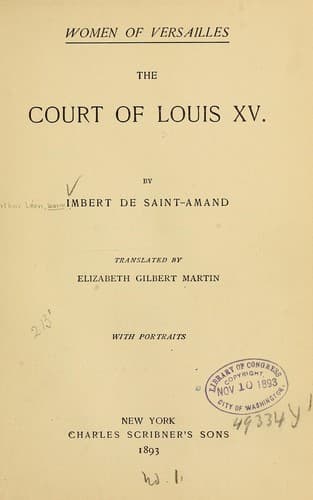
France -- Court and courtiers; France -- History -- Louis XV, 1715-1774
Madame de Pompadour’s existence had been like a parody of real
greatness. It was the same with her obsequies. A Capuchin had been
appointed to make the funeral oration. He extricated himself from this
heavy task like a man of wit. “I receive,” said he, “the body of the
very high and powerful lady, the Marquise de Pompadour, lady of the
Queen’s palace. She was at the school of all virtues, for Her Majesty
is a model of goodness, of modesty, of indulgence.” And thus he went
on for a quarter of an hour, making a well-deserved eulogy of the
Queen. Marie Leczinska, always so charitable, was struck by the extreme
promptness with which the too celebrated favorite was forgotten. “No
one has anything more to say here of her who is no more,” she remarked
to President Hénault, “than if she had never existed. Such is the
world; truly it is worth while to love it!”
Once dead, Madame de Pompadour seemed unworthy even of hatred. Still,
the men of letters and the artists who had formerly been protected
by her, regretted her somewhat. Voltaire, while remembering with
bitterness that she had sustained Crébillon, wrote to M. de Cideville:
“I have been much afflicted by the death of Madame de Pompadour. It
is ridiculous that an old scribbler on paper, who can scarcely walk,
should be still living, and that a beautiful woman should die at forty
in the midst of the finest career in the world. Perhaps if she had
tasted the repose that I enjoy she would be living still.” Diderot
was more severe. He had to give a description of the Salon of 1765,
where a picture was exhibited which Vanloo had painted during Madame
de Pompadour’s illness, and which represented the afflicted Arts
addressing themselves to Destiny to obtain the preservation of her
life. “Vanloo’s suppliants,” said the critic, “obtain nothing from
Destiny which is more favorable to France than to the Arts. Madame de
Pompadour died at a moment when she was thought to be out of danger.
Well! what remains of this woman who exhausted us of men and money,
deprived us of honor and energy, and upset the political system of
Europe? The treaty of Versailles, which will last as long as it can;
Bouchardon’s Amour, which will always be admired; several stones
sculptured by Guay, which will astonish future antiquaries; a good
little picture by Vanloo, which will be looked at sometimes; and a
pinch of dust.”
XIII
THE OLD AGE OF MARIE LECZINSKA
Public-domain text, read in full here on John Shaqi.
Reviews
Reviews
No reviews yet
Be the first to share your thoughts on this work.
Elsewhere in the archive
Join the Discussion
Join the discussion
Sign in to leave a comment or review.
Sign InorCreate an account