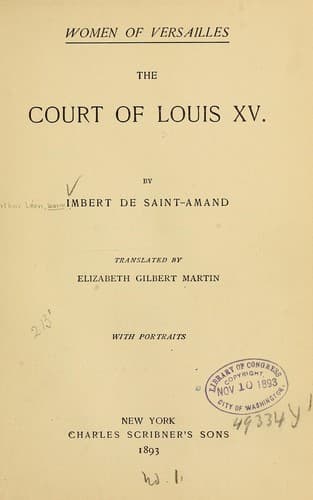
France -- Court and courtiers; France -- History -- Louis XV, 1715-1774
When the eyes have been fatigued by the glow of artificial lights, they
willingly repose on soft and real daylight. After the haughty favorite,
one likes to contemplate the good Queen. Comparisons made between the
mistress and the legitimate wife are always to the advantage of the
second. To one the agitations of a troubled conscience, to the other
peace of heart; to one contempt, to the other respect; scandal to
one, edification to the other. The Memoirs of the Duke de Luynes and
of President Hénault make us acquainted with the qualities of Marie
Leczinska, just as those of Madame du Hausset lay bare the moral plague
spots of the Marquise de Pompadour. A solitary conclusion may be drawn
from reading all of them; namely, that the Queen, neglected as she
was, and in spite of the hidden rôle which contented her modesty, was,
notwithstanding, less unhappy than the all-powerful favorite, who
disposed of the monarchy as if it were a pension list. Each of them had
her chagrins, but God gives us strength to endure the ills He sends
us, while those we create for ourselves are intolerable. The heaviest
chains are those we forge with our own hands. The list of suicides
is a proof in support of this observation. Is there, for example, an
affliction more profound than that of a mother who loses her child?
Very well! you never hear that a woman has taken her life because she
has had a grief like that. On the other hand, how many suicides there
are among the victims of pride and sensuality! Religion alleviates the
sorrows which are in the nature and order of things. But griefs which
are in revolt against Providence, afflictions voluntarily created by
criminal caprices, or insensate ambitions, have in them something
inconsolable and incurable. Madame de Pompadour vainly sought an asylum
for her soul.
The Queen found at the foot of altars such a strength that after
kneeling before the image of our Saviour Jesus Christ, she could, on
rising, drink the cup of bitterness without its leaving a trace upon
her lips.
Public-domain text, read in full here on John Shaqi.
Reviews
Reviews
No reviews yet
Be the first to share your thoughts on this work.
Elsewhere in the archive
Join the Discussion
Join the discussion
Sign in to leave a comment or review.
Sign InorCreate an account