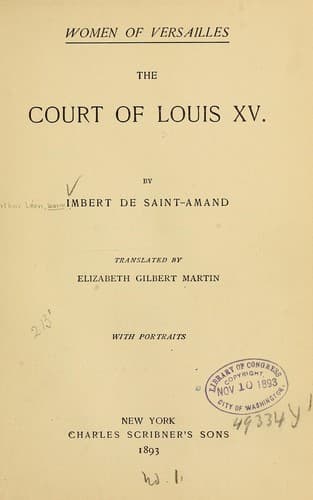
France -- Court and courtiers; France -- History -- Louis XV, 1715-1774
While the guilty mistress beheld with such spite and vexation the
departure of her youth, the virtuous wife experienced neither pain
nor regret at growing old. It is the privilege of honest women to
accept the laws of our common destiny without a murmur, and not to
attempt a foolish struggle against nature in the hope of repairing
the irreparable ravages of years. The Marquise loaded her face,
withered by anxieties, with rouge and powder, and exhausted all the
science of a desperate coquetry in the effort to keep up an illusion.
Marie Leczinska, on the contrary, did not entertain for a moment the
thought of rejuvenating herself. Casanova, who was present at one
of her dinners at Fontainebleau, represents her as “without rouge,
simply dressed, her head covered with a large cap, old-looking and
devout in aspect.” This wholly Christian simplicity was not without
its charm. The Queen possessed not merely goodness but wit, and her
qualities were reflected on her spiritual countenance without the least
pettiness, venerable with no touch of moroseness. While Louis XV. and
his mistresses were so sad, so disillusionized, so disenchanted with
everything, though surrounded by all their voluptuous pleasures, Marie
Leczinska never uttered a complaint. Gaiety was in reality the basis of
her character, not that factitious, turbulent, ephemeral gaiety which
vice knows for a moment, but that soft, continuous, unaffected, equable
gaiety imparted by a serene disposition and a conscience in repose.
What an expression of soundness, of moral wellbeing! What patience
with life, what sympathetic serenity! The Queen is interested in
many things; she is fond of honest amusements. Unlike Louis XV.,
who is bored by everything, she has a taste for music; she paints a
little, she embroiders, she plays the guitar, the hurdy-gurdy, the
harpsichord; she willingly takes part in games of chance. President
Hénault introduces us into the cabinet, whither she withdraws after
having dined alone in public, in accordance with the formalities of
etiquette: “Here,” he says, “we are in another climate; this is no
longer the Queen, but a private person. Here one finds work of all
descriptions, tapestry, arts of every sort, and while she is working
she kindly tells us what she has been reading; she mentions the parts
that have impressed her and appreciates them.”
Public-domain text, read in full here on John Shaqi.
Reviews
Reviews
No reviews yet
Be the first to share your thoughts on this work.
Elsewhere in the archive
Join the Discussion
Join the discussion
Sign in to leave a comment or review.
Sign InorCreate an account