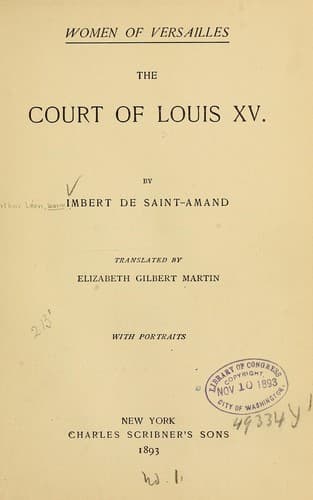
France -- Court and courtiers; France -- History -- Louis XV, 1715-1774
In a twinkling the four sisters were gathered around their father. At
six in the evening, at the unbooting of the King after the chase, as
people said in those days, the princesses came to pay a visit to Louis
XV., but this time with a certain etiquette. “The princesses,” says
Madame Campan again, “put on an enormous hoop which supported a skirt
braided with gold and embroideries. They fastened a long train to
their waist, and hid the negligence of the rest of their habiliments
by a large cape of black taffeta, which covered them up to the chin.
Knights of honor, ladies, pages, equerries, ushers, carrying large
torches, accompanied them to the King. In an instant the whole palace,
usually solitary, was in movement; the King kissed each princess on her
forehead.” In reality, he found more true happiness in the virtuous
intimacy of his daughters than in the circle of his courtiers and the
arms of his favorites. There were moments when people believed that
in growing old the debauchee would become wise. “The King,” wrote
D’Argenson, “seems to wish for no society but that of his family, like
a patriarch and a good man.”
Marie Leczinska felt thankful to her husband for the affection he had
for his daughters. The relations of Mesdames with their mother were
full of confidence, sweetness, and gaiety. They liked to enter those
little apartments of the Queen, where Marie Leczinska forgot the
splendor of the throne to live modestly as a good mother. The little
apartments[64] comprised three rooms: a salon, a bathroom, and a studio
for painting. Madame the Countess d’Armaillé, whose graceful and solid
work we have so often had occasion to quote, has given a charming
description of these three rooms in which Marie Leczinska spent the
greater portion of her time. “Is it not true,” she says, “that one
may divine the character and tastes of a woman by merely inspecting
the sanctuary of her private life, or, to speak more simply, that
place in the dwelling where she habitually prefers to stay? It matters
little whether this room be a garret or a drawing-room. Nothing is so
intimate as certain interior arrangements; nothing tells the story of
a woman better than the way in which she orders the room she inhabits.
In the little apartments of the Queen one found everything which makes
the charm of a peaceful existence. Here, pieces of work begun for the
poor, or for churches, a whole piece of furniture embroidered by her
hand; there, an open harpsichord with Moncrif’s cantatas, Rameau’s
operettas, Polish hymns; further away a drawing-table, a spinning-wheel
provided with its distaff, frames for embroidering and weaving, a
small printing-press; then flowers, paintings, portraits of children,
miniatures. On a console, a vase offered by Marshal de Nangis, a
manuscript given by Cardinal de Fleury, a porcelain pagoda with verses
by Madame de Boufflers; in an embrasure of the window a cabinet
containing the Queen’s favorite books, with some verses by the Duchess
Public-domain text, read in full here on John Shaqi.
Reviews
Reviews
No reviews yet
Be the first to share your thoughts on this work.
Elsewhere in the archive
Join the Discussion
Join the discussion
Sign in to leave a comment or review.
Sign InorCreate an account