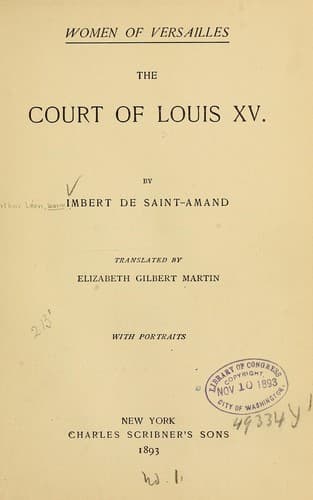
France -- Court and courtiers; France -- History -- Louis XV, 1715-1774
de Luynes; everywhere souvenirs of friendship, of maternal tenderness,
of useful or agreeable occupations.” It was there that, surrounded by
her children, the virtuous Queen tasted the joys of the heart, those
joys imparted only by a good conscience, and which the mistresses for
whom Louis XV. deserted her had never known.
XV
THE DAUPHINESS MARIE JOSÈPHE OF SAXONY
Marie Leczinska was not less happy in her son than in her daughters.
The bad examples of the court had not spoiled the upright and honest
nature of the Dauphin. As is said by Baron de Gleichen in his Memoirs,
the piety of the young prince was enlightened, and his policy foresaw
the dangers of irreligion. As son and father, as brother and husband,
he never ceased to display the qualities of a good and virtuous
heart. He had deeply mourned his first wife, that sympathetic Spanish
Infanta, who died in 1746, when hardly twenty years old. Reasons of
State demanded that, in spite of his great sorrow, he should promptly
contract a second marriage.
Louis XV. selected for his son a princess of the house of Saxony,
after Austria and Prussia the most powerful of the Empire. He intended
thus to consolidate his German alliances. Marshal Saxe, natural
son of Augustus II., King of Saxony, Elector of Poland, and of the
beautiful Countess Aurora of Königsmark, was the principal agent of the
negotiation which was to form a pact of union between his new country
and his old one. A learned Saxon diplomatist, now in the service of
Austria, Count Vitzthum, published some years ago an excellent work,
based on unpublished documents and letters in the archives of Dresden,
on the Marshal and the princess who espoused the Dauphin.
Marie Josèphe of Saxony, daughter of Augustus III., was at this time
fifteen years old. She was an agreeable young person, with large
blue eyes that were at once keen and gentle. Her countenance was
intelligent, her character excellent, her education complete. Marshal
Saxe wrote to his brother, Augustus III.: “Sire, what shall I say to
you? I find this affair advantageous at all points for your family, and
I shall descend without regret to the empire of the shades after I have
seen it terminated; I shall have accomplished my career. I have enjoyed
the delights of this world; glory has covered me with its benefits;
nothing more remained to me but to be useful to you, and all my destiny
will have been fulfilled in a most satisfactory manner.”
Marshal Saxe wrote to the wife of Augustus III., mother of the future
Dauphiness:--
Public-domain text, read in full here on John Shaqi.
Reviews
Reviews
No reviews yet
Be the first to share your thoughts on this work.
Elsewhere in the archive
Join the Discussion
Join the discussion
Sign in to leave a comment or review.
Sign InorCreate an account