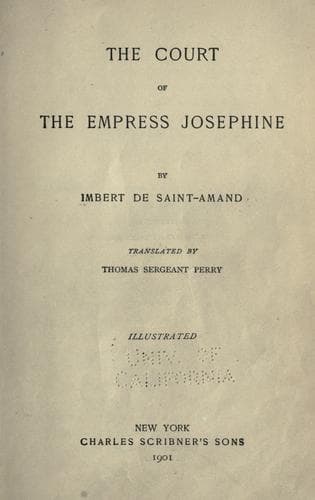
The Court of the Empress JosephineImbert de Saint-Amand
History
The Court of the Empress Josephine
Imbert de Saint-Amand
Josephine, Empress, consort of Napoleon I, Emperor of the French, 1763-1814
Produced by Anne Soulard, Charles Aldarondo, Keren Vergon,
Shawn Wheeler, and the Project Gutenberg Online Distributed
Proofreading Team
THE COURT OF THE EMPRESS JOSEPHINE
BY
IMBERT DE SAINT-AMAND
TRANSLATED BY THOMAS SERGEANT PERRY
ILLUSTRATED
1900
CONTENTS.
CHAPTER
I. THE BEGINNING OF THE EMPIRE
II. THE JOURNEY TO THE BANKS OF THE RHINE
III. THE POPE'S ARRIVAL AT FONTAINEBLEAU
IV. THE PREPARATIONS FOR THE CORONATION
V. THE CORONATION
VI. THE DISTRIBUTION OF FLAGS
VII. THE FESTIVITIES
VIII. THE ETIQUETTE OF THE IMPERIAL PALACE
IX. THE HOUSEHOLD OF THE EMPRESS
X. NAPOLEON'S GALLANTRIES
XI. THE POPE AT THE TUILERIES
XII. THE JOURNEY IN ITALY
XIII. THE CORONATION AT MILAN
XIV. THE FESTIVITIES AT GENOA
XV. DURING THE CAMPAIGN OF AUSTERLITZ
XVI. THE MARRIAGE OF PRINCE EUGENE
XVII. PARIS IN THE BEGINNING OF 1806
XVIII. THE MARRIAGE OF THE PRINCE OF BADEN
XIX. THE NEW QUEEN OF HOLLAND
XX. THE EMPRESS AT MAYENCE
XXI. THE RETURN OF THE EMPRESS TO PARIS
XXII. THE DEATH OF THE YOUNG NAPOLEON
XXIII. THE END OF THE WAR
XXIV. THE EMPEROR'S RETURN
XXV. THE COURT AT FONTAINEBLEAU
XXVI. THE END OF THE YEAR 1807
I.
THE BEGINNING OF THE EMPIRE.
"Two-thirds of my life is passed, why should I so distress myself about
what remains? The most brilliant fortune does not deserve all the trouble
I take, the pettiness I detect in myself, or the humiliations and shame I
endure; thirty years will destroy those giants of power which can be seen
only by raising the head; we shall disappear, I who am so petty, and those
whom I regard so eagerly, from whom I expected all my greatness. The most
desirable of all blessings is repose, seclusion, a little spot we can call
our own." When La Bruyere expressed himself so bitterly, when he spoke of
the court "which satisfies no one," but "prevents one from being satisfied
anywhere else," of the court, "that country where the joys are visible but
false, and the sorrows hidden, but real," he had before him the brilliant
Palace of Versailles, the unrivalled glory of the Sun King, a monarchy
which thought itself immovable and eternal. What would he say in this
century when dynasties fail like autumn leaves, and it takes much less
than thirty years to destroy the giants of power; when the exile of to-day
repeats to the exile of the morrow the motto of the churchyard: _Hodie
mihi, eras tibi?_ What would this Christian philosopher say at a time when
royal and imperial palaces have been like caravansaries through which
sovereigns have passed like travellers, when their brief resting-places
have been consumed by the blaze of petroleum and are now but a heap of
ashes?
Public-domain text, read in full here on John Shaqi.
Reviews
Reviews
No reviews yet
Be the first to share your thoughts on this work.
Join the Discussion
Join the discussion
Sign in to leave a comment or review.
Sign InorCreate an account