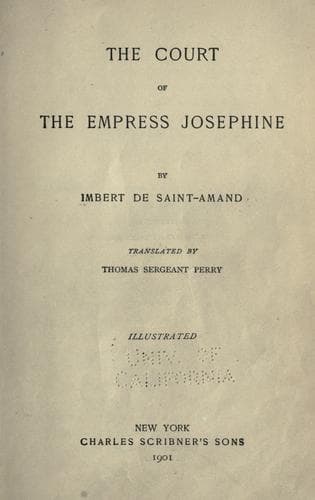
The Court of the Empress JosephineImbert de Saint-Amand
History
The Court of the Empress Josephine
Imbert de Saint-Amand
Josephine, Empress, consort of Napoleon I, Emperor of the French, 1763-1814
Before having himself crowned by the Pope, after the example of
Charlemagne, Napoleon was anxious to go to meditate at the tomb of the
great Carlovingian Emperor, of whom he regarded himself as the worthy
successor. A journey on the banks of the Rhine, a triumphal tour in the
famous German cities which the France of the Revolution had been so proud
to conquer, seemed to the new sovereign a fitting prologue to the pomp of
the coronation. Napoleon was desirous of impressing the imaginations of
people in his new Empire and in the old Empire of Germany. He wished the
trumpets of fame to sound in his honor on both banks of the famous and
disputed river.
The Empress, who had gone to Aix-la-Chapelle to take the waters, arrived
there a few days before her husband. Napoleon wrote to her, August 6,
1804:--
"MY DEAR: I have been here at Calais since midnight; I am thinking of
leaving this evening for Dunkirk. I am satisfied with what I see, and I am
tolerably well. I hope that you will get as much good from the waters as I
get from going about and from seeing the camps and the sea. Eugene has
left for Blois. Hortense is well. Louis is at Plombieres. I am very
anxious to see you. You are always essential to my happiness. A thousand
kind messages."
The Emperor wrote again from Ostend, August 14, 1804:--
"MY DEAR: I have not heard from you for several days, though I should have
been glad to hear that the waters have done you good and how you pass your
time. I have been here a week. Day after to-morrow I shall be at Boulogne
for a tolerably brilliant festival. Send me word by the messenger what you
mean to do, and when you shall have finished your baths. I am much
satisfied with the army and the fleet. Eugene is still at Blois. I hear no
more about Hortense than if she were at the Congo. I am writing to scold
her. Many kind wishes for all."
Napoleon reached Aix-la-Chapelle September 3. The Emperor Francis had, on
the 10th of August, assumed the Imperial title accorded to his house, of
Emperor-elect of Germany, Hereditary Emperor of Austria, King of Bohemia
and Hungary. He had then given orders to M. de Cobentzel to go to Aix-la-
Chapelle to present his credentials to Napoleon. Napoleon received the
Austrian diplomatist very kindly, and was soon surrounded by a multitude
of foreign ambassadors who came to pay their respects. He re-established
the annual honors long before paid to the memory of Charlemagne, went down
into the vault, and gave the priests of the Cathedral convincing proofs of
his munificence. The Empress was shown a piece of the true cross which the
Carlovingian Emperor had long worn on his breast as a talisman. She was
offered a holy relic, almost the whole arm of that hero, but she declined
it, saying that she did not wish to deprive Aix-la-Chapelle of so precious
a memorial, especially when she had the arm of a man as great as
Charlemagne to support her.
Public-domain text, read in full here on John Shaqi.
Reviews
Reviews
No reviews yet
Be the first to share your thoughts on this work.
Join the Discussion
Join the discussion
Sign in to leave a comment or review.
Sign InorCreate an account