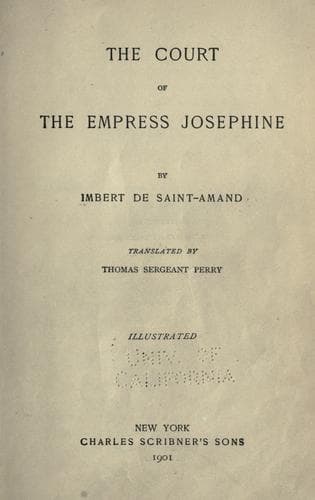
The Court of the Empress JosephineImbert de Saint-Amand
History
The Court of the Empress Josephine
Imbert de Saint-Amand
Josephine, Empress, consort of Napoleon I, Emperor of the French, 1763-1814
From Aix-la-Chapelle, Napoleon and Josephine went to Cologne, then to
Coblentz, then to Mayence, travelling separately. The Emperor left Cologne
September 16 at four in the afternoon, and reached Bonn a little before
nightfall, to start again the next morning. The town pleased her very
much, and she was sorry she could not remain there longer. She stayed at a
fine house with a garden opening on a terrace that looked out over the
Rhine. After supper she walked on the terrace. The delight of the people
assembled below, the peacefulness of the night, and the beauty of the
river in the moonlight, made the evening most enjoyable. At four the next
morning the Empress started off again in her travelling carriage, and at
ten she entered Coblentz. The Emperor did not get there until six in the
evening, having left Cologne the same day. At Bonn he got on horseback to
examine for himself everything that demanded close inspection. From
Coblentz, where a ball was given them, Napoleon and Josephine went to
Mayence, each by a different route. The Emperor followed the highway on
the edge of the Rhine; the Empress ascended the river in a yacht which the
Prince of Nassau Weilburg had placed at her disposal. It was a picturesque
voyage.
The morning mist soon cleared away. Josephine, who had breakfast served on
deck, admired the many charming scenes between Boppard and Bacharach, the
fertile fields, the towns perched on the steep banks; in the distance, the
mountains covered with forests; then the narrowing river, the bounded
view, the cliffs crowded together, where nothing can be seen but the
river, the sky, and the crags crowned by the mirrored towns of mediaeval
castles. The light boat, as it glided smoothly over the stream, with its
gilded Neptune at the bow, recalled Cleopatra's barge. At times the
silence was profound, then the church-bells would be heard, as well as the
cheers of the peasants on the river-banks. The pettiest villages had sent
guards of honor, had hoisted flags, and raised triumphal arches. Curiously
enough, the right bank, which did not belong to France, seemed to display
quite as much zeal and enthusiasm as the left bank, the French one; on
both sides were the same shouts of welcome, the same demonstrations, the
same salutes. When she reached Saint Goar, on the left bank, the Empress
saw the authorities of the town coming out to meet her, with military
music, in boats decorated with branches of trees; and on the other side of
the river, on the terrace of the castle of Hesse Rheinfels, the Hessian
garrison was presenting arms, and their salutes joined with those of the
inhabitants of Saint Goar, Further on, they shouted through a speaking-
trumpet to hear the famous echo of the Lorelei, with its wonderfully
distinct and frequent repetitions. Then they passed the fantastic castle
of the Palatinate, built in the middle of the stream, and in old times the
refuge of the Countesses Palatine, where their children were born and kept
Public-domain text, read in full here on John Shaqi.
Reviews
Reviews
No reviews yet
Be the first to share your thoughts on this work.
Join the Discussion
Join the discussion
Sign in to leave a comment or review.
Sign InorCreate an account