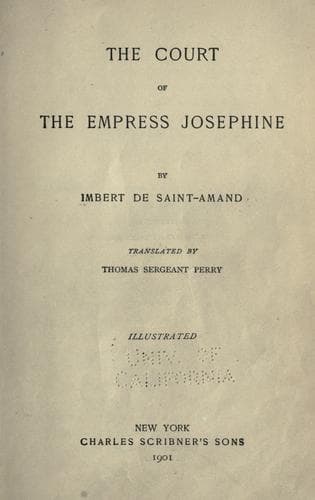
The Court of the Empress JosephineImbert de Saint-Amand
History
The Court of the Empress Josephine
Imbert de Saint-Amand
Josephine, Empress, consort of Napoleon I, Emperor of the French, 1763-1814
Josephine awaited with impatience and fear an event on which, she felt,
her future fate depended. The Pope, that mysterious and holy person, had
started. Was he to prove her saviour? Was she to be a repudiated wife or a
crowned Empress? The clergy were untiring in their laudations of
Napoleon's glory. Bishops, in their charges, spoke of him as God's elect.
One prelate, speaking of the Empire, had said: "One God and one monarch!
As the God of the Christians is the only one deserving to be adored and
obeyed, you, Napoleon, are the only man worthy to rule the French!"
Another had said: "Napoleon, whom God called from the deserts of Egypt,
like another Moses, will bring peace between the wise Empire of France and
the divine Empire of Christ. The finger of God is here. Let us pray the
Most High to protect with his powerful hand the man he has chosen. May the
new Augustus live and rule forever! Submission is his due because he is
ordered by Providence!" Yet in spite of these extravagant outbursts which
came from every pulpit in the whole French Empire, this restorer of the
altars, this saviour of religion was married only by civil right! From the
ecclesiastic point of view, he was living in concubinage. He had had his
brother Louis's marriage with Hortense de Beauharnais, and his sister
Caroline's with Murat blessed by Cardinal Caprara, but in spite of
Josephine's entreaties, he had denied her this pious satisfaction. It was
on the Pope that the Empress put all her hope; she thought that he would
take pity on her, and by bringing her into conformity with the rules of
the church, would put an end to a condition of things humiliating to her
as a sovereign, and painful to her as a Catholic.
At the same time Josephine was anxiously wondering whether she was to be
crowned. Her brothers-in-law became more venomous in their intrigues
against her, and desired not only that she be excluded from any part in
the coronation, but also that she should be condemned to divorce on the
pretext of barrenness. Joseph Bonaparte was never tired of saying that
Napoleon ought to marry some foreign Princess, or at least some daughter
of an old French family, and he skilfully laid stress on his own
unselfishness in urging a plan which would necessarily remove himself and
his descendants from the line of inheritance. The Emperor's sisters showed
the same hostility towards Josephine, whom they hated, although she well
deserved their love. Since Napoleon maintained an absolute silence about
his intentions concerning the coronation, the Bonapartes already imagined
that she was going to be divorced, and hence exhibited an untimely delight
which displeased the Emperor and brought him closer to his wife. At last,
tired with family bickerings, he suddenly put an end to them and filled
Josephine with joy by telling her that she was to be crowned at Notre
Dame.
Public-domain text, read in full here on John Shaqi.
Reviews
Reviews
No reviews yet
Be the first to share your thoughts on this work.
Join the Discussion
Join the discussion
Sign in to leave a comment or review.
Sign InorCreate an account