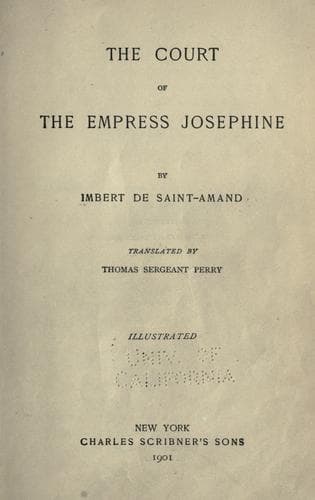
The Court of the Empress JosephineImbert de Saint-Amand
History
The Court of the Empress Josephine
Imbert de Saint-Amand
Josephine, Empress, consort of Napoleon I, Emperor of the French, 1763-1814
The reader should turn to the curious account in Miot de Melito's Memoirs
of the council held at Saint Cloud, November 17, 1804, to arrange the
formalities of the coronation. Of Napoleon's four brothers, two were in
disgrace, Lucien and Jerome, and they were not to be present at the
ceremony. As for Joseph and Louis, it was decided that they should appear,
not as Princes of the blood, but only as high dignitaries of the Empire.
Joseph, it will be remembered, was Grand Elector, and Louis was Constable.
This decision once taken, Joseph said in the council of November 17:
"Since it has been recognized that, with the exception of the Head of the
State, no one else, whatever his rank, can be regarded as partaking the
honors of sovereignty, and that we especially are not treated as Princes,
but only as high dignitaries, it would not be right that our wives, who
henceforth are only wives of high dignitaries, should as Princesses carry
the train of the Empress's robe, which consequently must be carried by
Ladies of Honor or of the Palace." This remark displeased the Emperor, and
many members of the council cited many examples to refute it, notably that
of Maria de' Medici. Joseph, who had foreseen their arguments, displayed
unexpected erudition: "Maria de' Medici," he said, "was accompanied only
by Queen Margaret, the first wife of Henri IV., and by Madame (Catherine
of Bourbon), the King's sister. The train was carried by a very distant
relative. Queen Margaret had, indeed, offered a fine example of generosity
by being present at the coronation of the woman who took her place and
who, more fortunate than herself, had borne heirs to Henri IV. But she was
not asked to carry the train of Maria de' Medici, and yet Maria de' Medici
had a right to every honor, because she was a mother." This very
transparent allusion to Josephine's barrenness so exasperated Napoleon
that he arose suddenly from his chair and addressed his brother with the
intensest bitterness and violence. After the meeting Joseph proposed to
his brother retiring to Germany. Napoleon relented and, November 27, he
said to his brother: "I have given a great deal of thought to the
difference that has arisen between you and me, and I will confess that
during the six days that this quarrel has lasted, I have not had a
moment's peace. I have even lost my sleep over it, and you are the only
person who has this power over me; I know nothing that disturbs me to this
degree. This influence comes from my old affection for you and from my
recollection of what you did for me in my boyhood, and I am much more
dependent than you think on feelings of that sort.... Take your position
in an hereditary monarchy and be the first of my subjects. That is a fine
enough position, to be the second man in France, perhaps in Europe....
Comply with my wishes; follow my ideas; do not flatter the patriots when I
drive them away; do not oppose the nobles when I summon them; form your
Public-domain text, read in full here on John Shaqi.
Reviews
Reviews
No reviews yet
Be the first to share your thoughts on this work.
Join the Discussion
Join the discussion
Sign in to leave a comment or review.
Sign InorCreate an account