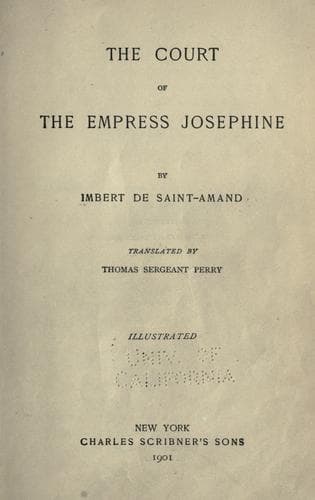
The Court of the Empress JosephineImbert de Saint-Amand
History
The Court of the Empress Josephine
Imbert de Saint-Amand
Josephine, Empress, consort of Napoleon I, Emperor of the French, 1763-1814
Another difficulty which gave the Pope much anxiety, and was not settled
in the formalities of the coronation, was whether the Emperor should
receive the crown from the hands of the Sovereign Pontiff. Pius VII. had
brought up the question before leaving Rome, and Cardinal Consalvi had
written on this matter, to which the Vatican attached great importance, as
follows: "All the French Emperors, all those of Germany, who have been
crowned by the Popes, have accepted the crown from them. The Holy Father,
before undertaking this journey, requires to receive from Paris the
assurance that there will be no innovation made in the present case, in
the way of a diminution of the honor and dignity of the Sovereign
Pontiff." At Rome only vague and dilatory answers had been received. In
Paris the Emperor, leaving the matter to be decided on the spur of the
moment, had only said: "I will arrange that myself."
The preparations at Notre Dame had come to an end. They had been very
considerable. Several houses that hid the north facade had been destroyed.
Before the great entrance, still scarred by the ravages of the
Revolutionists, there had been set up a decoration of painted wood,
representing a vast Gothic porch with three arches upholding the statues
of the thirty-six good cities, the mayors of which were to be present at
the coronation. To the right and the left stood images of Clovis and
Charlemagne, sceptre in hand. Above, between two golden eagles, appeared
the Imperial coat-of-arms. This was intended for the sole entrance of the
Pope and the Emperor. It was connected with the Archbishop's palace by
large, covered, wooden galleries, adorned within by gobelin tapestry. This
palace, to which Pius VII. and Napoleon were to go before they entered the
Cathedral, no longer exists; it was destroyed, February 14, 1831, in an
insurrection. It used to stand just by the side of the church. It was
built in 1161 by Maurice de Sully, rebuilt in 1697 by the Cardinal of
Noailles, embellished in 1750 by the Archbishop de Beaumont, and was the
meeting-place of the Constituent Assembly from October 19 to November 9,
1789. There the Pope and the Emperor were to alight on their way from the
Tuileries and put on their grand coronation robes before entering the
Cathedral.
Public-domain text, read in full here on John Shaqi.
Reviews
Reviews
No reviews yet
Be the first to share your thoughts on this work.
Join the Discussion
Join the discussion
Sign in to leave a comment or review.
Sign InorCreate an account