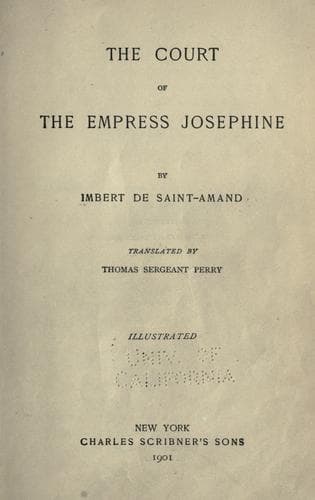
The Court of the Empress JosephineImbert de Saint-Amand
History
The Court of the Empress Josephine
Imbert de Saint-Amand
Josephine, Empress, consort of Napoleon I, Emperor of the French, 1763-1814
The whole church of Notre Dame had been hung with crimson stuffs adorned
with gold fringe, with the arms of the Empire embroidered on the corners.
On each side of the nave and around the choir had been built three rows of
galleries, decorated alike with silk and velvet stuffs fringed with gold,
and flags had been arranged like a trophy about each pillar. Above the
trophies were winged and gilded victories, holding candelabra with a vast
number of candles. There were, besides, twenty-four chandeliers hanging
from the roof. The galleries kept out the light, especially at the season
when the days were short; consequently it had been decided that the
Cathedral should be artificially lit during the ceremony, thus augmenting
the pomp and beauty of the spectacle. The choir, shut off by a railing,
was reserved for the clergy. To the right of the high altar, on a platform
with eleven steps, had been raised the pontifical throne, above which was
a golden dome adorned with the arms of the Catholic, Apostolic, and Roman
Church. In front and on each side of the pontifical throne were benches
with backs for the cardinals and prelates. For the Emperor and the Empress
had been prepared what was called the great and the little throne. The
little throne was formed of two armchairs, one for Napoleon, the other for
Josephine. These two chairs stood on a platform with four steps, opposite
the high altar. The Emperor and Empress were to occupy them during the
first part of the ceremony. The grand throne was at the other end of the
church, with its back against the great door, which was thus closed. This
great throne stood on a large semicircular platform, and was reached by
twenty-four steps. It stood under a canopy in the shape of a triumphal
arch, upheld by eight columns, and it overlooked the whole church. The
Emperor and the Empress were not to ascend this throne till after the
coronation.
For the coronation Napoleon had given to the Cathedral a number of holy
vessels in silver-gilt, enriched with diamonds, and very valuable lace
albs, a processional cross, chandeliers, and incense-burners. At the same
time he restored to the Cathedral a great number of relics with which the
piety of Saint Louis had endowed the Sainte Chapelle. In 1791 they had
been deposited in the treasury of Saint Denis, by order of Louis XVI.,
thence in 1793 they had been transferred to the cabinet of curiosities in
the National Library, and had been exposed under the Directory, in the
Hall of Antiquities. The Emperor restored them to the worship of the
faithful.
Public-domain text, read in full here on John Shaqi.
Reviews
Reviews
No reviews yet
Be the first to share your thoughts on this work.
Join the Discussion
Join the discussion
Sign in to leave a comment or review.
Sign InorCreate an account