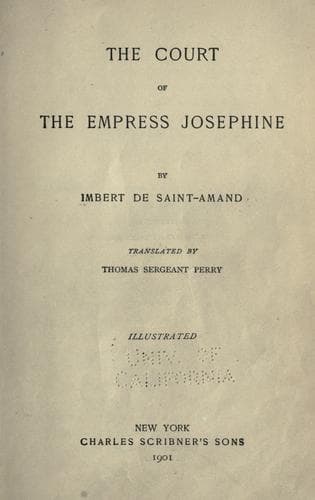
The Court of the Empress JosephineImbert de Saint-Amand
History
The Court of the Empress Josephine
Imbert de Saint-Amand
Josephine, Empress, consort of Napoleon I, Emperor of the French, 1763-1814
After thus crowning himself, Napoleon proceeded to crown the Empress. This
was the most solemn moment in Josephine's life; the moment which dispelled
all her incessant dread of divorce, the brilliant verification of her
fondest hopes, the completion of her triumph. Napoleon advanced with
emotion to this companion of his happiest days, to the woman who had
brought him happiness; she was kneeling before him, shedding tears of joy
and gratitude, with her hands clasped and trembling. He recalled all that
he owed her: his happiness, for, thanks to her, he had been blessed with a
requited love; his glory, for it was she who, in 1796, had secured for him
the command of the Army of Italy, the origin of all his triumphs. He must
have been glad at this moment that he had not followed his brother's
malicious suggestions and had not separated from his dear Josephine! The
affection of the young General Bonaparte revived in the heart of the
sovereign. He thought Josephine more gracious, more touching, more lovable
than ever, and it was with an outburst of happiness that he placed the
Imperial diadem on her charming and cherished head.
The Emperor and Empress, once crowned, proceeded to the great throne, at
the entrance of the church, by the great door, being solemnly led there by
the Pope and the Cardinals. The Imperial procession then formed again in
the order in which it had come to Notre Dame, the Empress going before the
Emperor. At this moment the Princesses seemed to hesitate about carrying
the skirt of the Empress's cloak; Napoleon noticed this, and said a few
severe, firm words to his sisters, and all was smoothed. The procession
reached the foot of the great throne; the Emperor ascended the twenty-four
steps and sat down in full majesty, wearing his crown and Imperial cloak,
holding the hand of justice and the sceptre. At his right, on a seat like
his, but one step lower, the Empress placed herself. Another step lower,
sat the Princesses on simple seats. At the Emperor's left, two steps below
him, were the Princes and high dignitaries. On each side of the platform
the marshals, high officers, and ladies of the court took their places.
The sight was most impressive. The Pope in his turn ascended the twenty-
four steps, and thus commanding the whole Cathedral, extended his hands
over the Emperor and the Empress, and uttered these Latin words, the
formula used for taking the throne: "_In hoc solio confirmare vos Deus, et
in regno aeterno secum regnare faciat Christus!_"--"May God establish you
on your throne, and may Christ cause you to reign with him in his eternal
kingdom!" Then he kissed the Emperor on the cheek, and turning towards the
assembled multitude, said: "_Vivat Imperator in aeternum!_"--"May the
Emperor live forever!" This was what had been said ten centuries before at
Saint Peter's in Rome when the ruler of the same people, Charlemagne, had
been proclaimed Emperor of the West.
Public-domain text, read in full here on John Shaqi.
Reviews
Reviews
No reviews yet
Be the first to share your thoughts on this work.
Join the Discussion
Join the discussion
Sign in to leave a comment or review.
Sign InorCreate an account