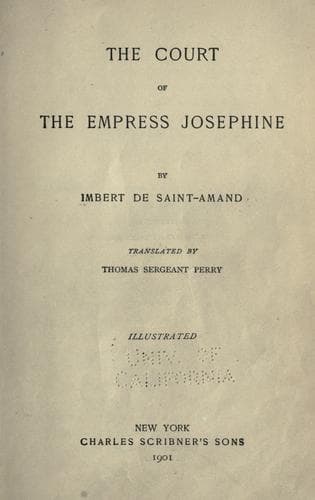
The Court of the Empress JosephineImbert de Saint-Amand
History
The Court of the Empress Josephine
Imbert de Saint-Amand
Josephine, Empress, consort of Napoleon I, Emperor of the French, 1763-1814
Applause broke forth and three hundred musicians intoned the _Vivat
Imperator_, a hymn composed by the Abbe Rose. The pontifical procession
and the Imperial procession returned to the choir; the Emperor and Empress
resumed their places on the chairs, and the Pope began, the _Te Deum_.
After this, which was sung by four choirs and two orchestras, the mass,
which had been interrupted by the ceremony with the ornaments and the
taking possession of the throne, went on. At the offertory, Napoleon and
Josephine, followed by the two Princes and the five Princesses, went to
lay their offerings before the Pope; these consisted of a silver-gilt
vase, a lump of gold, a lump of silver, and a candle about which were
inlaid thirteen pieces of money. At the elevation Prince Joseph removed
the Emperor's crown, and Madame de La Rochefoucauld, Maid of Honor, that
of the Empress. Napoleon and Josephine knelt before the Host, and when
they rose, put their crowns on again.
When mass was over, the Emperor took the political oath prescribed by the
constitution, which had aroused much opposition in Rome. The presidents of
the great bodies of the state brought him the formula, and with one hand
held over the gospels, the Emperor swore to maintain, the principles of
the Revolution, to preserve the integrity of the territory, and to rule
with an eye to the interest, happiness, and glory of the French people.
The First Herald-at-Arms then called forth in a loud voice: "The most
glorious and most august Emperor Napoleon, Emperor of the French, is
crowned and enthroned: Long live the Emperor!" That was the end of the
ceremony. Salvos of artillery mingled with the applause.
The solemnity had been most successful, and Napoleon could say with truth
to his brother Joseph: "For me it is a battle won; by my art and the
measures I took, I have succeeded beyond my expectations." Had he not
prophesied accurately when he said to his secretary at the signing of the
Concordat: "Bourrienne, you will see what use I shall make of the
priests!" The golden chasubles had made a brilliant spectacle by the side
of the uniforms; the crosses and the tiara by the side of the swords and
the sceptre. Napoleon, always a master of theatrical effect, had known how
to lend antiquity to his newborn glory by borrowing from the past all its
majesty and pomp, and by skilfully decking himself with what was most
brilliant in the chronicles of remote centuries. From Charlemagne he took
his insignia; from Caesar his golden laurel. The head of a nation that had
grown great by the cross and the sword, he desired to make his coronation
the festival of the church and of the army.
Public-domain text, read in full here on John Shaqi.
Reviews
Reviews
No reviews yet
Be the first to share your thoughts on this work.
Join the Discussion
Join the discussion
Sign in to leave a comment or review.
Sign InorCreate an account