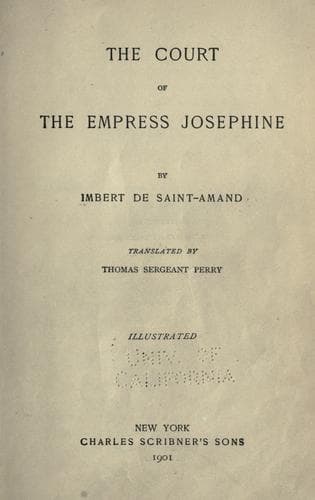
The Court of the Empress JosephineImbert de Saint-Amand
History
The Court of the Empress Josephine
Imbert de Saint-Amand
Josephine, Empress, consort of Napoleon I, Emperor of the French, 1763-1814
Alas! these flags were to be always on the path of honor, but not always
on the path of victory, for victory is a female goddess and a fickle one.
Against how many enemies these flags were to be defended, beneath
scorching suns, under avalanches of ice and snow! What heroism, what
miracles of bravery, were to be witnessed by these standards on many a
battle-field! What fatigue, what suffering, what sacrifices, dangers,
wounds, how many glorious deaths, what seas of blood, to come at last to
the most lamentable disasters I Had the future been seen, those drums
would have been draped in black. But the army imagined itself invincible.
The thought of defeat would have called forth a smile of pity. Proud of
itself, of its commander, it shouted with joy and pride as it passed
before the throne.
A single incident disturbed this martial ceremony. Suddenly an unknown
young man approached the Imperial gallery, and shouted: "Down with the
Emperor! Liberty or death!" This ardent Republican was at once arrested.
His voice had been lost in the music and clatter of arms.
The rain continued, and soon soaked through the canvas and stuffs
sheltering the throne, The Empress was obliged to leave, with her
daughter, who had recently given birth to a child. The other Princesses
followed this example, with the exception of Madame Murat, who, although
lightly clad, remained exposed to the showers. She said that she was
learning how to endure the inevitable discomforts of the highest rank.
At five o'clock Napoleon and Josephine were once more at the Tuileries
where a state dinner was given in the Gallery of Diana. In the middle of
this gallery the table of the Emperor and the Empress was placed beneath a
magnificent canopy, on a platform. The Empress sat there with the Emperor
on the right and the Pope on her left. The high officers of the crown, as
well as a colonel-general of the Guard and a prefect of the palace,
remained standing near the Imperial table.
Pages waited on the tables. The Archchancellor of the German Empire took
his place at that of the Emperor. In the same gallery were set other
tables for the French Princes and for the hereditary Prince of Baden, for
the ministers, for the ladies and officers of the Imperial household.
After the dinner was a concert, at which the Pope consented to be present.
When that was over Pius VII. withdrew, and the evening ended with a ballet
danced by the dancers of the opera in the great hall called since the
Empire the Hall of the Marshals.
VII.
THE FESTIVITIES.
Public-domain text, read in full here on John Shaqi.
Reviews
Reviews
No reviews yet
Be the first to share your thoughts on this work.
Join the Discussion
Join the discussion
Sign in to leave a comment or review.
Sign InorCreate an account