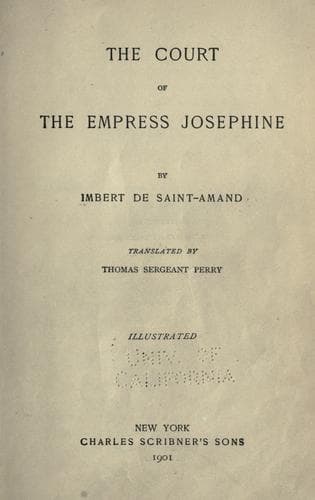
The Court of the Empress JosephineImbert de Saint-Amand
History
The Court of the Empress Josephine
Imbert de Saint-Amand
Josephine, Empress, consort of Napoleon I, Emperor of the French, 1763-1814
The winter of 1804-5 was very brilliant. Napoleon was anxious to give the
beginning of his reign an air of splendor. He allowed his officials
generous salaries, but he insisted on their spending all they received in
sumptuous living, in entertaining freely, and receiving distinguished
foreigners. Luxury became compulsory, and trade flourished beyond all
expectations. Paris had never, even in the grandest days of the old
monarchy, known greater social animation. This martial generation,
accustomed to desire a short but merry life, aware that the festivities of
day would be interrupted by the battles of the next, were as eager in the
ball-room as on the battlefield. They hastened to enjoy their present
prosperity as if they foresaw the disasters to come. French gallantry,
which had been forgotten during the Revolution, resumed its sway. The
women were like the fair mistresses of castles in the Middle Ages who gave
their hearts to the bravest knights. Love and glory both became the
fashion. The former Lady of the Bedchamber to Marie Antoinette, Madame
Campan, who taught most of the young women of the court in her school at
Saint Germain, had formed a group of beauties, trained in aristocratic
manners, at the head of whom was her ablest, most intelligent pupil,
Hortense de Beauharnais, who had been married to Prince Louis Bonaparte.
The Grand Chamberlain, M. de Talleyrand, a poor bishop but an excellent
specimen of a grand lord, and the Grand Master of Ceremonies, M. de Segur,
whose success as ambassador of Louis XVI. at the court of Catherine was
very great, set the tone in the households of the Emperor and the Empress.
Napoleon set an example of luxury and elegance. Grand dinners, concerts,
official entertainments succeeded one another with startling rapidity.
Josephine, who was wildly fond of dress, was glad of an excuse to indulge
her extravagant tastes. The Emperor's three sisters lived like real
princesses, rivalling one another in magnificence. Princes Joseph and
Louis displayed the pomp of future kings.
Almost all the women of the court were young and pretty. It would have
been hard to confer on any one, to the exclusion of the rest, the palm of
beauty. There were three who were especially distinguished: Madame Maret
(later the Duchess of Bassano); Madame Savary (later the Duchess of
Rovigo); and Madame de Canisy (later the Duchess of Vicenza). The last
named had married M. de Canisy, the Emperor's equerry. Later, she got a
divorce and married M. de Caulaincourt, Duke of Vicenza and Grand Equerry.
Public-domain text, read in full here on John Shaqi.
Reviews
Reviews
No reviews yet
Be the first to share your thoughts on this work.
Join the Discussion
Join the discussion
Sign in to leave a comment or review.
Sign InorCreate an account