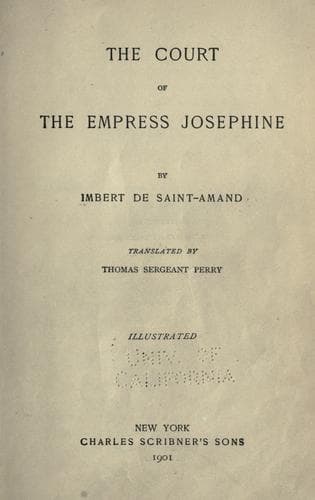
The Court of the Empress JosephineImbert de Saint-Amand
History
The Court of the Empress Josephine
Imbert de Saint-Amand
Josephine, Empress, consort of Napoleon I, Emperor of the French, 1763-1814
standards, were Latin inscriptions in honor of Napoleon. Before dinner he
was presented with a table-service of silver-gilt by the city of Paris.
Then he took his seat, with the Empress, on a platform beneath a canopy,
and the meal began. During dinner, a band, hidden behind green foliage,
played a symphony of Haydn's, and then was sung a cantata full of flattery
for the Emperor and the Empress.
After the dinner there were magnificent fireworks. As the first rockets
rose, a second cantata was sung. One of the pieces of fireworks
represented a man-of-war with eighty guns: its decks, masts, sails, and
rigging were represented by glowing lights. Another, which the Emperor
himself set off, represented Mount Saint Bernard sending forth a volcanic
eruption from snow-covered rocks. In the centre appeared the image of
Napoleon at the head of his army, riding up the steep slope of the
mountain.
This entertainment, which closed with a ball at which seven hundred
persons were present, was a real apotheosis. Madame de Remusat, speaking
of the extravagant adulation devised for this occasion, says: "A great
deal has been said about the fulsome flatteries of Louis XIV. during his
reign; I am sure that altogether they would not amount to a tenth part of
those that Bonaparte received. I remember that at another festivity given
by the city to the Emperor a few years later, since all inscription had
been exhausted, there were placed above the throne on which he was to sit,
these words from Scripture, in gold letters: _Ego sum qui sum_,--and no
one was shocked."
The Senate and the Legislative Body also gave grand entertainments in
honor of the coronation. That of the Legislative Body was particularly
brilliant. This assembly, which rivalled the Senate in obsequiousness, had
decided that a marble statue should be raised to the Emperor in the room
where it sat, in honor of the drawing up of the civil code. The day when
this statue was to be inaugurated was chosen for the festivity. The
Empress, followed by a magnificent suite, reached the Palace of the
Legislative Body at about seven in the evening. As she entered, musicians
intoned Glueck's famous chorus, which used to be sung on formal occasions
in the reign of Louis XVI., in honor of Marie Antoinette:--
"What charms! What majesty!"
Unanimous applause emphasized the allusions. Then on the President's
invitation, Marshals Murat and Massena raised the veils that covered the
statue, and all eyes beheld the figure of Napoleon, wearing on his brow a
laurel wreath, in which were mingled oak and olive leaves. Later, at the
time of his abdication at Fontainebleau, Napoleon expressed a regret that
he had permitted his statue to be made during his lifetime.
Public-domain text, read in full here on John Shaqi.
Reviews
Reviews
No reviews yet
Be the first to share your thoughts on this work.
Join the Discussion
Join the discussion
Sign in to leave a comment or review.
Sign InorCreate an account