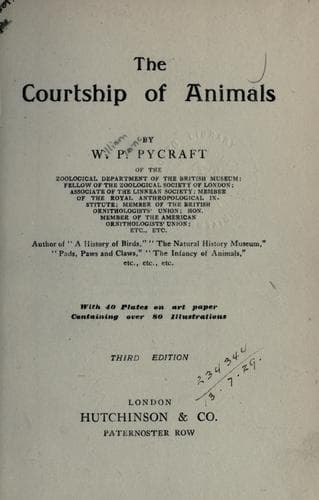
The Courtship of AnimalsPycraft, W. P. (William Plane)
Science
The Courtship of Animals
Pycraft, W. P. (William Plane)
Animal behavior; Natural selection
Amorousness, then, is the dominant feature of the males among all
animals: and this sex presents yet another characteristic which is to
be borne in mind. In all that concerns the evolution of ornamental
characters the male leads. In him we can trace the trend which
evolution is taking; the female and young afford us the measure of the
advance along the new line which has been taken. Why this should be is
inexplicable. But sooner or later the females assume, or will assume,
all the features originally possessed by their lords; and finally the
young also follow suit. That is to say, the females and young tend to
retain the ancestral characters. In the course of time the ability to
develop new features by the male loses its impetus, and not till then,
apparently, do the females, and still later, the young, begin to share
his glory. These remarkable features are strikingly illustrated among
the birds, as these pages will show.
Nature is nothing, if not perverse. And hence it happens that there
are many exceptions to every rule which one formulates. Among the
birds, for example, there are species wherein the rule that the female
follows her mate in the acquisition of new characters is, so to
speak, set aside. She follows a line of her own. This is true, at any
rate, of superficial characters, such as coloration. By some curious
change in her “metabolism,” as the conversion into living tissue of
the substances taken as food is called, this coloration may attain
a brilliance in no way inferior to that of the male, but strikingly
different. The beautiful Orange Fruit-pigeon (_Chrysoenas victor_)
furnishes a case in point, the male being of a gorgeous orange-yellow,
the female of a no less vivid green. But the differences are not so
great as they appear at first sight. For the male was originally green,
and the female has thus but intensified the ancestral livery. Green,
it should be remarked, of a more or less olive shade, always precedes
yellow in development; and yellow may yield to red, but this order is
never reversed. A no less striking case is that of the Upland Goose
(_Cloephaga magellanica_), the male of which is pure white, while the
female wears a livery of chestnut and brown. But so sharply are the
colours defined that it would be difficult to say that one was of a
higher order of coloration than the other. To what causes or factors
are these departures due?
Public-domain text, read in full here on John Shaqi.
Reviews
Reviews
No reviews yet
Be the first to share your thoughts on this work.
Join the Discussion
Join the discussion
Sign in to leave a comment or review.
Sign InorCreate an account