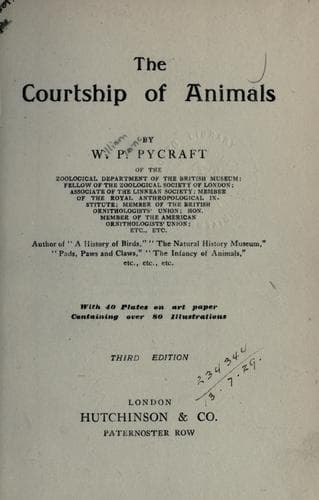
The Courtship of AnimalsPycraft, W. P. (William Plane)
Science
The Courtship of Animals
Pycraft, W. P. (William Plane)
Animal behavior; Natural selection
In like manner the individual—the complex bundle of parts and
qualities—must attain, and maintain, a certain harmony with its
environment—the outer world. The process of change, both in quality
and quantity, which is for ever going on among the several parts of
every separate individual, brings about the elimination of unfavourable
variations; and “selects” those which vary in the right direction:
that is to say, which serve to maintain a place in the sun for the
individual in which these momentous changes are going on. But it is not
enough that the individual should be in “working order”; it must be in
harmony with all the conditions on which existence depends. And the
standard of this harmony is set by that very exacting arbiter of life
and death, “Natural Selection.” It is not enough that the instincts
in regard to this or that habit should be keen, or that this or that
particular organ of the body should be efficient—a certain minimum,
all-round, standard of efficiency is demanded, or elimination follows.
It is through this instability of “temperament,” this tendency to vary
in infinite directions, that the balance between the individual and
the environment is maintained. Evolution follows the line of least
resistance.
The little boy who remarked that it must be “fiddling work, making
flies,” was more sage than he knew. The complex web of factors which
even a fly represents are beyond the grasp of human understanding. But
it is clear that the reproductive instincts, and the emotions they
beget, have played, and play, a tremendous part in the evolution of the
higher animals.
Those whose business it is, for one reason or another, to study
these emotions know well that “mate-hunger” may be as ravenous as
food-hunger, and that, exceptions apart, it is immensely more insistent
in the males than in the females. But for this, reproduction in many
species could not take place: for the sexes often live far apart, and
mates are only to be won after desperate conflict with powerful rivals
no less inflamed. Thus it is idle to speak of an equality between the
sexes in this matter, in regard to the human race. Dogmatism, and the
frequent repetition of pretty platitudes, will not alter what Nature
has ordained. The failure to realize this is painfully obvious in
the utterances of many who speak in the name of the newly-founded
“Eugenics” society, which seeks the means to ensure the well-being
of the race by the spread of a more intimate knowledge of this
all-important subject. The existence of what Mr. Heape has recently
called a “sex-antagonism” is beyond dispute, for the instincts of the
male and female are fundamentally different. The male is dominated
by the desire to gratify the sexual appetite; in the female this is
counteracted by the stimulation of other instincts concerned with the
cares of offspring.
Public-domain text, read in full here on John Shaqi.
Reviews
Reviews
No reviews yet
Be the first to share your thoughts on this work.
Join the Discussion
Join the discussion
Sign in to leave a comment or review.
Sign InorCreate an account