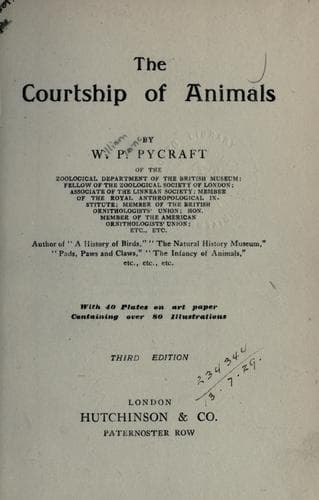
The Courtship of AnimalsPycraft, W. P. (William Plane)
Science
The Courtship of Animals
Pycraft, W. P. (William Plane)
Animal behavior; Natural selection
By no process of analysis known to us could the germ-plasm of man be
distinguished from that of, say, a jelly-fish; and in the matter of
quantity there is no more difference. Yet, identical to our senses, in
potentiality how amazingly different are these two particles of jelly!
In the lowliest animals, such as jelly-fish, one cannot distinguish
male and female at sight. The appearance of separate male and female
individuals begins somewhat high in the scale marking an epoch in
the history of animal life. For the birth of sex inaugurated not
merely individuals producing distinctive “male” and “female” germs,
but individuals which, by virtue of their sex, developed differences
of behaviour and mentality which were to be followed by tremendous
consequences. Certain aspects of this behaviour are to furnish the
theme of these pages; others, and no less important, those who will may
discover in Professor Arthur Thomson’s “Evolution of Sex.”
We are far, indeed, from being able to explain the attributes of sex.
At most, we can but endeavour to interpret the behaviour associated
therewith. This was the task which Darwin set himself to achieve in
his theory of sexual selection. He was influenced in the train of
thought which he followed up with such brilliant success by what he had
observed in the behaviour of highly-ornamented species, such as the
Peacock and the Birds of Paradise. The strange antics of these birds
when under the influence of sexual excitement persuaded him that they
were at least dimly conscious of their splendour, and of its power
to fascinate. The female, on the other hand, was supposed to be coy,
and to bestow her person on the finest performer. In this way the
dullest birds and the poorest performers were gradually eliminated.
Here, indeed, was sexual selection. The frills thus begotten he called
“Secondary Sexual Characters,” a term which is also used, and was used,
by him, to include any feature whereby the sexes can be distinguished
apart from the character of the genital organs.
Horns, tusks, and spurs are other forms of secondary sexual characters.
And these stand for another form of sexual selection—that of selection
by battle. Herein victory falls to the strongest and most pugnacious
male who, as the spoils of victory, annexes the females which formed
the subject of the duel. This theory, which must be discussed at
greater length in the course of these pages, has had many critics,
and among them men of mark. But whatever modifications may be deemed
necessary, they will be such as are demanded by the results of later
discoveries rather than to the force and subtlety of the arguments of
his opponents.
Public-domain text, read in full here on John Shaqi.
Reviews
Reviews
No reviews yet
Be the first to share your thoughts on this work.
Join the Discussion
Join the discussion
Sign in to leave a comment or review.
Sign InorCreate an account