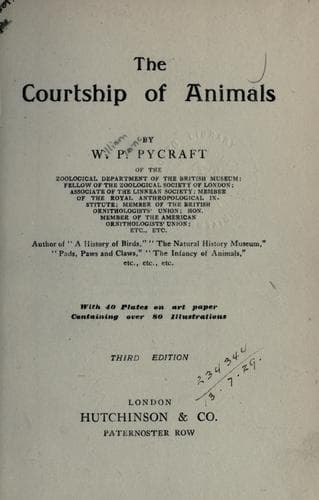
The Courtship of AnimalsPycraft, W. P. (William Plane)
Science
The Courtship of Animals
Pycraft, W. P. (William Plane)
Animal behavior; Natural selection
One of the most formidable of the opponents of the Sexual Selection
theory was Wallace. But his arguments were far from convincing, and
often inconsistent. He attributed the more frequent occurrence in male
animals of brilliant coloration and exaggerations of growth such as
give rise to manes, beards, long plumes, and so on, to a “surplus of
strength, vitality and growth-power which is able to expend itself
in this way without injury,” or, as he sometimes expresses it, to
superabundant vitality. He was evidently striving to find words for
the faith that was in him, and he was nearer the truth than he knew
or than his critics supposed. He was seeking facts which only the
physiologist could furnish. And these made their appearance long years
after with Professor Starling’s discovery of Hormones. We are far from
understanding the origin of these mysterious juices which must be so
frequently alluded to in these pages, but they are evidently intimately
associated with the expenditure of energy. This may sometimes find an
outlet in increased stature, sometimes in pure luxuries of growth. The
force of Wallace’s arguments was crushed out by the weight of detail
they were made to bear.
Mr. J. T. Cunningham a few years ago entered the lists and failed to
achieve his purpose no less completely. His was a theory which assumed
too much. In the first place it was based on the transmissibility of
acquired characters, of the truth of which there is at present no
evidence.
He contends, for example, that the vivid hues of scarlet, blue, yellow
and violet which colour the naked skin of the neck of the cassowaries
and of both sexes, and the curious horny casque which surmounts the
head, are the outcome of the constant laceration of the skin inflicted
by the males during their conflicts for the possession of the females.
He assumes that such conflicts take place, and he assumes that such
“acquired characters” are transmitted. Now, as a matter of fact, these
birds do not fight with their beaks, but with their feet. And to this
end the claw of the inner toe is enlarged to form a great spur. But
there is no evidence that the skin of the neck is ever damaged in such
conflicts as they may engage in. No scars are ever found, at any rate,
to lend support to this theory. The casque, which is similarly supposed
to be a mark of honourable conflict, is an “ornament” of great frailty,
for it is composed of a delicate filigree-work of bone covered with a
thin sheath of horn. In like manner, the long plumes which surmount the
heads of birds like the Peacock, and many Birds of Paradise, and the
wattle which surmounts the beak of the Turkey, are supposed to have
had their origin in similar pugilistic encounters in the past. Mr.
Cunningham is surely pushing the theory of the transmission of acquired
characters a little far. For what has been transmitted in these cases
is not a number of scarred surfaces, but a series of hypertrophied
structures.
Public-domain text, read in full here on John Shaqi.
Reviews
Reviews
No reviews yet
Be the first to share your thoughts on this work.
Join the Discussion
Join the discussion
Sign in to leave a comment or review.
Sign InorCreate an account