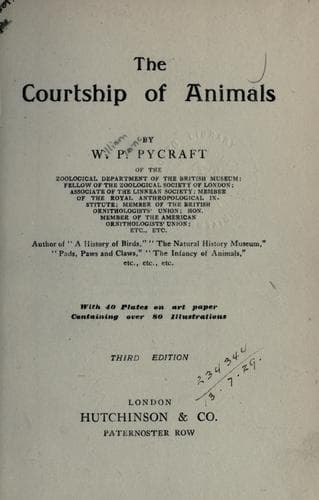
The Courtship of AnimalsPycraft, W. P. (William Plane)
Science
The Courtship of Animals
Pycraft, W. P. (William Plane)
Animal behavior; Natural selection
An amazing array of ornamental characters, symmetrically
disposed, and often vividly coloured, in short, has been produced from
lacerated tissues which in kind and extent can have varied but little.
Evidence has been accumulating during the last few years which would
have rejoiced the heart of Darwin. Had he known that birds of sober
hues “display” with the same animation and with as much elaboration
of posture as the Peacock and the Pheasant, his theory of “Sexual
Selection “would probably have left little for those who came after him
to criticize. Since his time it has been discovered that both permanent
and recurrent secondary sexual characters, such as the antlers of
deer and the temporary nuptial plumage of birds, such as the Ruff for
example, are controlled as to their growth by the stimulating action
of the “secretions or juices formed by certain of the ductless glands
“; that is to say, of glands having no apparent connection with their
surrounding tissues. We owe much of our knowledge of this subject to
Professor Starling, who has called these secretions “Hormones.”
Darwin knew that the essential sexual glands, the testes and the
ovaries, in some mysterious way controlled, in a large degree, the
development of these “hall-marks” of sex, for it was known in his
time that castrated stags failed to produce antlers, and that hen
pheasants, for example, in extreme old age, or when the ovaries were
damaged by disease or injury, at once assumed the plumage of the cock;
but the part played by these ductless glands was quite unsuspected.
They are the Thyroid, and the Thymus glands, which are attached to
the outer walls of the trachea or windpipe. The Pituitary body, which
forms part of the brain, and the Suprarenal bodies, attached to the
kidneys. It would be foreign to the purpose of these pages to enter
into the functions of these glands; suffice it to say, that the juices
formed therein are taken up by the blood, and distributed over the
system. Their action is only very imperfectly understood. We know
that any derangement in their efficiency results in disease, and that
they play a very important part in the reproductive system, as will
become abundantly evident in the course of these pages. Much hitherto
attributed to the action of “Sexual Selection” alone, it is now evident
is largely due to their action.
Public-domain text, read in full here on John Shaqi.
Reviews
Reviews
No reviews yet
Be the first to share your thoughts on this work.
Join the Discussion
Join the discussion
Sign in to leave a comment or review.
Sign InorCreate an account