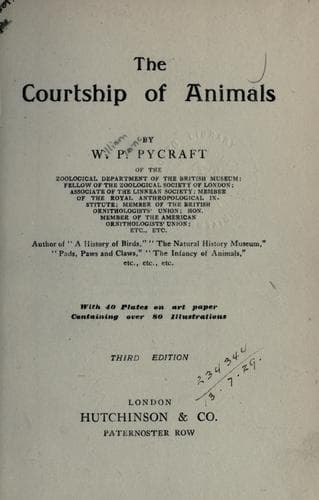
The Courtship of AnimalsPycraft, W. P. (William Plane)
Science
The Courtship of Animals
Pycraft, W. P. (William Plane)
Animal behavior; Natural selection
Having regard to the fact that three thousand species of Perlidæ are
known, and that they have a wide distribution over the earth’s surface,
one might have expected that more would be known of their singular
life-history. They are, however, flies of very unattractive appearance
and great frailty, hence, save to anglers, by whom they are esteemed as
bait for trout, they attract but little attention.
CHAPTER XII
SCORPIONS, SPIDERS AND CRABS
Musical Lovers among Spiders and Scorpions—Colour among Spiders, and
its uses—The Spiders’ Dance of Death—Spiders and Conjugal Bliss—How
Pairing is accomplished—Scorpions in Love—Musical Crabs—Quarrelsome
Fiddler-crabs—Crabs and Courtship in the Deep Sea—Amazons among
Prawns—Brine-shrimps and Water-fleas—“Natural” _v._ “Sexual” Selection.
It is a curious and significant fact that in the most brilliantly
coloured of the Invertebrates—the Butterflies and Moths—” courtship”
in the sense of “wooing” is extremely rarely met with; and this is
quite contrary to what the Sexual Selection theory of Darwin demands,
for, according to this, the colours are the result of that selection.
On the other hand, Spiders, which are for the most part dull-coloured
creatures, and the Scorpions, which are also dull-coloured, are
commonly extraordinarily demonstrative during the early stages of
“mate-hunger.” Some practise the form of instrumental music known as
“stridulation,” others dance and indulge in other forms of posturing.
In the Spiders the stridulating apparatus is formed either between
the limb-bearing portions of the body, or “cephalothorax,” and the
abdomen; between the palps or leg-like feelers, and the jaws; or
between these feelers and the front legs. But the construction is
similar in all. In some Spiders the abdomen bears a horny collar, which
is toothed, and these teeth, as the abdomen is raised and depressed,
scrape against a number of delicate ridges on the thorax, or “chest,”
which form a surface recalling that of a file. The grating of these
opposing surfaces against one another produces shrill rasping or
chirping sounds, which, in some cases at any rate, seem to be designed
to inform the female of the presence of a suitor. Those who will,
may examine this strange instrument for themselves if they will take
the trouble to seek for it in one of our commonest English Spiders
(_Steatoda bipunctata_). That it serves as a sexual excitant, or as
an aid to mate-hunting, is indicated by the fact that it is found in
males only, or in a very rudimentary condition in the female. There is
a large Spider in Assam (_Chilobrachys stridulatus_) which produces
a sound like the drawing of the back of a knife along the edge of a
strong comb; and there are others which, by the friction of the feelers
against the jaws, produce sounds like the buzzing of bees. One of the
Wolf-spiders (_Lycosa kochy_) is known as the “purring” or “drumming”
Spider from its custom, at mating-time, of rapidly drumming on dead
Public-domain text, read in full here on John Shaqi.
Reviews
Reviews
No reviews yet
Be the first to share your thoughts on this work.
Elsewhere in the archive
Join the Discussion
Join the discussion
Sign in to leave a comment or review.
Sign InorCreate an account