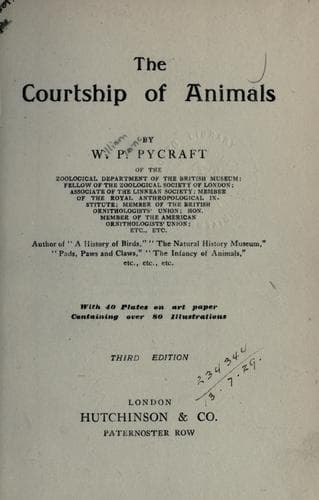
The Courtship of AnimalsPycraft, W. P. (William Plane)
Science
The Courtship of Animals
Pycraft, W. P. (William Plane)
Animal behavior; Natural selection
The males, apparently, fully realize the perils which their amours may
lead them into. They haunt the borders of the webs of unmated females,
but exhibit a hesitating, irresolute manner. For hours they will linger
near her, feeling the silken carpet cautiously with their legs, and
apparently trying to ascertain the nature of the welcome likely to be
extended to them. The odds are against them: for even if allowed to
mate, unless they are extraordinarily agile in slipping away the moment
they have attained their object, the chances are they will be slain and
eaten!
Among some species, however, matters are otherwise: for the males of
the genus _Linyphia_, for example, are generally to be found living
peacefully with their consorts.
More rarely the male weaves a small nuptial tent, into which he
partly leads and partly drives the female: though the “driving” would
appear to be merely for form’s sake! The habits of the Cellar Spider
(_Tegenaria parietina_), a long-legged species fairly common in the
South of England, affords a yet further interesting and instructive
contrast with the foregoing accounts. The pairing habits of this
species have been studied by many observers, but perhaps the best
account is that of Mr. F. M. Campbell. He found, to begin with, that in
this species the tender ties of mating are at any rate rarely violated
by the horrible aftermath of cannibalism so common a feature with so
many other Spiders.
One or two illustrations from Mr. Campbell’s work must suffice. On
one occasion he placed together a male and a female. For four days
they took no notice of one another; then the female cast what proved
to be her last skin, and within three hours after, the male began
to show signs of interest in her presence—which is a fact of some
significance, for not till then had she attained maturity. “After a
few convulsive twitchings of the legs, the male pressed forwards,
moving his palpi”—the leg like “feelers” on each side of the head
which form the genital organs (page 241)—“up and down, when, as they
touched the palpi of the female, the pair played with these organs
like two friendly bees with their antennæ. After a few minutes the
female raised herself, leaning a little on her left side, and the male
crept forward until his head was under the breast of his mate, while
his first pair of legs were resting upon hers. He now advanced his
right palpus, leaning a little to the left and using the left palpus
as part of his support. The right palpus was slightly twisted so as
to bring the surface (containing the fertilizing germs) opposite the
sexual organs of the female.... He now rapidly raised his palpus up and
down for four or more seconds, and with such energy as to compel her
to assume a vertical position. He then retired and again approached
her, repeating the movements ... occasionally pausing before he
withdrew his palpus.... At times he would leave the female for five
Public-domain text, read in full here on John Shaqi.
Reviews
Reviews
No reviews yet
Be the first to share your thoughts on this work.
Elsewhere in the archive
Join the Discussion
Join the discussion
Sign in to leave a comment or review.
Sign InorCreate an account