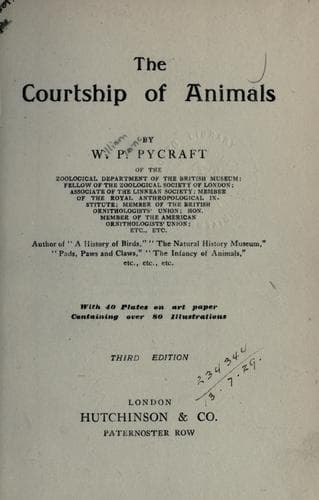
The Courtship of AnimalsPycraft, W. P. (William Plane)
Science
The Courtship of Animals
Pycraft, W. P. (William Plane)
Animal behavior; Natural selection
The subject of “Courtship” in so far as it applies to the human race
is one concerning which little can be said. Westermark, Letourneau,
Sutherland, and last but by no means least, Darwin, have brought
together a mass of facts bearing on the status of women among
communities, savage and civilized, ancient and modern, and from these
much may be inferred. To this harvest, however, Darwin himself still
remains the most important contributor on all that directly concerns
the “Sexual Selection” theory. Other writers seem to have paid more
attention to the laws governing the possession of women than to the
discussion of the motives which may have controlled the choice of
mates. Instances of amatory dalliance, such as are met with among
the inferior apes, and the birds, seem to be wanting. This negative
evidence seems to show that, even among the most ancient, the most
Ape-like, half-human races of man such dalliance was unknown. And this
because primitive man, in his love-making as in everything else, was
accustomed to take what he wanted, or die in the attempt. It is to
this forcefulness of character that the human race owes its progress
throughout the ages. But did he, when desire possessed him, exercise
any sort of choice, when this was possible? What were his standards?
These are unanswerable questions; at most we can but infer what his
behaviour may have been from observations on existing races of mankind.
These seem to demonstrate that while some races profess admiration for
certain of their physical peculiarities, these cannot be attributed to
the action of sexual selection.
It has been suggested that the low, beetling brows, protruding mouth,
and flat, broad nose which characterized the earliest human peoples,
were slowly eliminated by the æsthetic taste displayed by the females
in their choice of mates. Now in the first place, it is highly
improbable that they had any choice allowed them, and if they had,
these are just the characters which were most marked in the males and
might, or probably would, in consequence, have been deemed “manly” and
desirable, for it is hardly to be supposed that such people would be
capable of conceiving ideas of a possible refinement of their personal
appearance if they could but add to the height of their foreheads
and reduce the size of their faces. These graces settled down on
them as the brain enlarged and habits changed. But the process of
transformation must have been infinitely slow, and quite imperceptible
from one generation to another.
Public-domain text, read in full here on John Shaqi.
Reviews
Reviews
No reviews yet
Be the first to share your thoughts on this work.
Join the Discussion
Join the discussion
Sign in to leave a comment or review.
Sign InorCreate an account