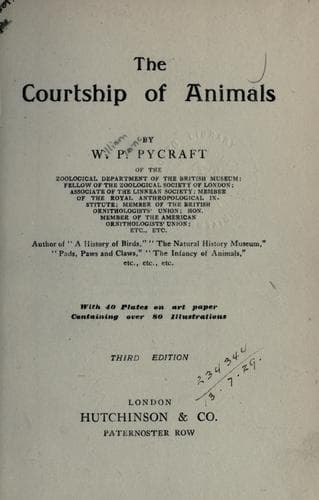
The Courtship of AnimalsPycraft, W. P. (William Plane)
Science
The Courtship of Animals
Pycraft, W. P. (William Plane)
Animal behavior; Natural selection
The absence of secondary sexual characters in man, such as the brightly
coloured areas which are so conspicuous a feature of many of the lower
apes, is to be explained by his fundamentally different mode of life.
Such vivid hues obtain only in species which live in troops, and
they serve as aphrodisiacs, ensuring mating to every female forming
a part thereof, which would be by no means certain were there no
external signs of her condition. Primitive man, like the higher apes,
was instinctively monogamous, and of necessity solitary, till he had
acquired a tolerable measure of self-control and neighbourliness. When
lust possessed him, he was obliged, in making his maiden venture to
scour the country in the search for the object of his desire. This
found, and won, probably only after desperate conflict with the head of
the family, the nuptial ceremonies would be short.
The greater physical strength of the male and his higher brain capacity
are probably the result of Natural, rather than of Sexual Selection.
The former would weed out all the weakly and dull-witted in the
ordinary course of the struggle for existence, the latter, during the
early days of man’s development, would award the prizes of life to the
most amorous and cunning, and to the most ambitious of the competitors.
The secondary sexual characters of the female are chiefly negative
characters, the absence of those which are conspicuous in the male. She
retains more of the primitive characters of the race. This is the rule
in regard to the animal kingdom. Wherever we desire to find the onward
tendency of evolution, the latest developments of the race, we turn
to the male; when we desire to learn something of the past history of
the species we turn to the female and young. This standard, of course,
yields by no means uniform results, for we find every gradation of
progress on the part of the latter, till male and female and young are
externally indistinguishable. But the order is almost invariably the
same—first the male, then the female, then the young. Thus progress is
more or less automatic or “Orthogenic,” as the scientific text books
have it, new characters, as they appear, tending to go on increasing
in amplitude till checked by Natural selection. It is to be noted,
however, that this transference is limited, for the female never
inherits characters which are concerned with aggressiveness to the same
degree as in the males, as witness, for example, the brow-ridges and
huge canines in the case of the gorilla.
Public-domain text, read in full here on John Shaqi.
Reviews
Reviews
No reviews yet
Be the first to share your thoughts on this work.
Join the Discussion
Join the discussion
Sign in to leave a comment or review.
Sign InorCreate an account