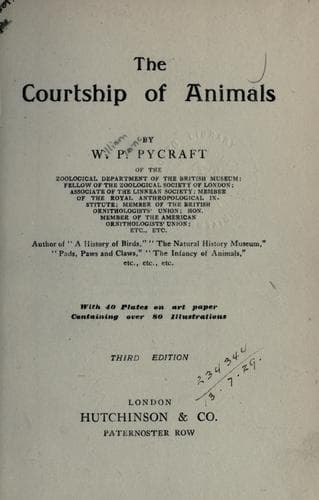
The Courtship of AnimalsPycraft, W. P. (William Plane)
Science
The Courtship of Animals
Pycraft, W. P. (William Plane)
Animal behavior; Natural selection
promptly begin to merge the one into the other till they twain become
one flesh in very truth. Here is the most primitive form of marriage
in Nature. And here, in this union, or fusion, of separate entities of
Germ-plasm, we have the beginning of sex. Such unions are common among
these primeval forms of life. In many cases this “marriage” takes place
between two particles of Protoplasm of which one is rather larger than
the other. In such case the smaller is regarded as male, the larger as
female. Here we have the first sign of “sexual differentiation” or the
evolution of “male” and “female” individuals.
Some such union, some such process of “rejuvenation” by the importation
of “fresh blood” seems to be imperative for the continuance of
existence throughout the whole animal world, even though it may take
place at rare intervals of time. Why should this be? Is this strange
meeting and commingling a matter of chance, or is the one seeking the
other possessed by a ravenous mate-hunger?
As we ascend higher in the scale it becomes apparent that life has
gathered force. That primitive speck of jelly, the Amœba, with which
we started, gave but two signs of animation—the power of movement,
and hunger. Whether these responses to internal stimuli can be called
instinctive is open to argument. But there can be no question about
the instinctive nature of the behaviour of these higher animals.
After the instinct to feed the two most powerful are the desire for
self-preservation—the avoidance of danger—and the desire to mate. These
two are the dominating instincts throughout the rest of the animal
world, not even excepting man himself.
The tremendous power of “mate-hunger” has been overlooked by a strange
confusion between cause and effect. Almost universally its sequel, the
production of offspring, has been regarded as the dominant instinct in
the higher animals. This view has no foundation in fact. “Desire” for
the sake of the pleasure it affords, and not its consequences, is the
only hold on life which any race possesses. And this is true both in
the case of man himself and of the beasts that perish. Wherever this
instinct becomes weak, or defective, extinction speedily and inevitably
follows. This “Amorousness” is the motive power of “Courtship” wherever
it is met with; manifesting itself in the eccentric, and often
grotesque posturings, or in the loud and often musical cries which
constitute the study of courtship. Intensity of desire is indispensable
to survival.
Public-domain text, read in full here on John Shaqi.
Reviews
Reviews
No reviews yet
Be the first to share your thoughts on this work.
Join the Discussion
Join the discussion
Sign in to leave a comment or review.
Sign InorCreate an account