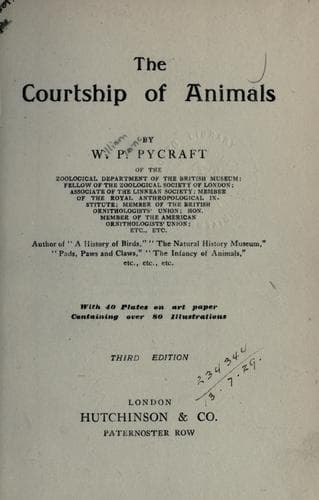
The Courtship of AnimalsPycraft, W. P. (William Plane)
Science
The Courtship of Animals
Pycraft, W. P. (William Plane)
Animal behavior; Natural selection
Only the lowly and sedentary types, of which the Oyster may be taken
as an example, lack this fire; and here because it is unnecessary. For
the reproductive germs of this animal are discharged into the water,
to take their chance of attaining their object. They are liberated
unconsciously, discharged like the undigested residue of the food,
without effort, and without cognizance of the act. This must be so,
for the Oyster merely lives—vegetates. Sightless, and without power
of movement, after its larval wanderings are over, it lives merely
to eat. And even in this, choice is denied it. The currents of water
mechanically brought to afford the necessary oxygen for the maintenance
of life, bring with them the food which is to restore the slowly
wasting tissues. To such a creature there can be no “outer-world,” no
consciousness of the existence of individuality other than its own.
The desire for sexual intercourse is met with only where the
co-operation of two individuals is necessary to ensure the production
of offspring. Such individuals being free to roam, must have some
incentive to seek one another at the time when their germ-cells have
attained maturity. And this incentive is furnished by the glands in
which these elements are produced: supplemented by the secretions
of certain ancillary glands. These stimulating juices, known as the
“Hormones,” will be presently described.
But if we owe our existence to the gratification of what may be called
our lower instincts, it is no less certain that all that is best in us
we owe to our offspring. We meet with the beginnings of altruism, which
the begetting of offspring entails, far down in the animal kingdom, and
it attains to its full perfection in the human race. Here only, in its
best and truest sense, Love begins: though affection may be found, and
in a high degree, in many of the lower animals.
Living things are as clay in the hands of the potter. But it is as if
they made themselves, for the designer and the guiding hand are alike
invisible. No vessel is exactly like its neighbour, either in the
quality of its substance or in the details of its construction. And
this because the clay of which it is made possesses that mysterious
property we call life. A property which endows each new feature as
it appears, with an individuality of its own, whose survival, or
suppression, depends entirely on its relationship to surrounding parts;
on its harmony with its environment, in short. Colour, size, shape,
temperament, behaviour, may each be regarded as so many entities
depending for survival on whether or not they can exist in harmony with
their environment—the several parts which make up what we call the
individual.
Public-domain text, read in full here on John Shaqi.
Reviews
Reviews
No reviews yet
Be the first to share your thoughts on this work.
Join the Discussion
Join the discussion
Sign in to leave a comment or review.
Sign InorCreate an account