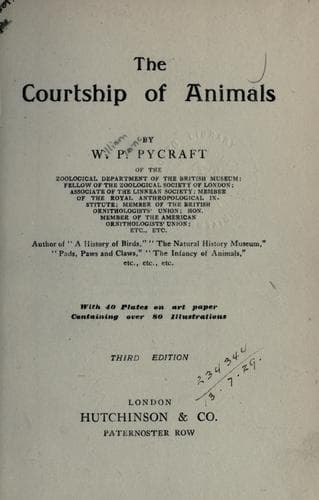
The Courtship of AnimalsPycraft, W. P. (William Plane)
Science
The Courtship of Animals
Pycraft, W. P. (William Plane)
Animal behavior; Natural selection
With some species, which, it should be remarked, also lack distinctive
colouring, the erotic state is manifested apparently not so much by the
display of expanded wings and tail as by frenzied dances. The Jacanas,
aberrant members of the Plover tribe resident in South America, are
expert performers, displaying moreover a curious spontaneity during
such outbursts. A flock will be apparently sedulously feeding when
suddenly and with quick, excited gestures all will cluster together in
a group and go through a singular and pretty performance, holding their
wings outstretched and agitated, some with a fluttering and others with
more leisurely movement, like that of a butterfly sunning itself. The
performance over, all scatter and feed again.. The Honourable Walter
Rothschild, in his “Avi-fauna of Laysan” tells us of the stately
Albatross, which breeds, or rather bred there—for the Japanese display
a singular callousness in regard to animal life where commercial
interests are concerned in thousands: “First they stand face to face,
then they begin nodding and bowing vigorously, then rub their bills
together with a whistling cry. After this they begin shaking their
heads and snapping their bills with marvellous rapidity, occasionally
lifting one wing, straightening themselves out and blowing out their
breasts; then they put their bills under the wing or toss them in the
air with a groaning scream, and walk round each other often for fifteen
minutes at a time.”
Cranes are much given to dancing. Mr. Nelson, an American
ornithologist, has described with much vigour the dancing of the
Sandhill Crane in Alaska. As he lay in a “hunting-blind” he was
suddenly aroused by the arrival of a crane, followed speedily by
a second, uttering his loud note as he came, until he espied the
first-comer on the ground, when he made a circuit and dropped close
by. Both birds then joined in a series of loud rolling cries in quick
succession. Suddenly, the last-comer, which seemed to be a male,
wheeled his back towards the female and made a low bow, his head nearly
touching the ground, and ending by a quick leap into the air. Another
pirouette brought him facing his charmer, whom he greeted with a still
deeper bow, his wings trailing loosely by his sides. She replied by an
answering bow and hop, and then tried to outdo the other in a series
of spasmodic hops and starts, mixed with a set of comically grave and
ceremonious bows. The pair stood for some moments bowing right and
left, when the legs appeared to become envious of the large share
taken in the performance by the neck, and then would ensue a series
of skilled hops and skips, like the steps of a minuet. Such antics
are characteristic of the Cranes of all species, and sometimes a
whole flock will join in such dances. But, it is to be noted, they are
not necessarily signs of the _furor amantium_: they certainly always
accompany this, but frequently they are indulged in, apparently, solely
Public-domain text, read in full here on John Shaqi.
Reviews
Reviews
No reviews yet
Be the first to share your thoughts on this work.
Elsewhere in the archive
Join the Discussion
Join the discussion
Sign in to leave a comment or review.
Sign InorCreate an account