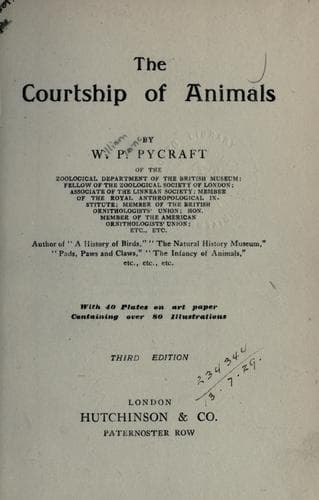
The Courtship of AnimalsPycraft, W. P. (William Plane)
Science
The Courtship of Animals
Pycraft, W. P. (William Plane)
Animal behavior; Natural selection
as an outlet for exuberance of feeling.
Before the theme of dancing can be dismissed the performance of a small
species of perching bird, one of the South American Manakins, must be
described. The natives call it the “Bailador,” or dancer. In an account
of his travels in Nicaragua Mr. Nutting tells us: “I once witnessed one
of the most remarkable performances it was ever my lot to see. Upon a
bare twig ... at about four feet from the ground, two male ‘bailadors’
were engaged in a song and dance act that simply astonished me. The two
birds were about a foot and half apart and were alternately jumping
about two feet in the air and alighting exactly on the spot whence they
jumped. The time was as regular as clockwork, one bird jumping up the
instant the other alighted, each bird accompanying himself to the tune
of to-le-do—to-le-do—to-le-do, sounding the syllable to as he crouched
to spring, le while in the air, and do as he alighted. This performance
was kept up without intermission for more than a minute, when the birds
suddenly discovered they had an audience and made off.” Here again we
have no evidence of the _furor amantium_; nor that any females were
spectators of the scene.
It is important to notice that Mr. Howard, in the course of his study
of the Warblers, witnessed a performance having some likeness to this
on the part of three young Sedge Warblers but newly escaped from
the nursery. And this not in some solitary instance, but on several
occasions. Just after leaving the nest, he remarks, they are very
playful, “their games sometimes taking the form of a tilting match.
Three take part; two sit on convenient twigs facing one another, and
the third, from the central position, might almost be called an umpire.
Numbers One and Two lower their heads, each in anticipation of the
other moving; one of them, call him Number One, then springs into
the air and darts at Number Two: Number Two dodges and occupies the
position vacated by Number One; each of them then faces round ready to
continue the fray, the change of positions becoming quite rapid.” But
no recurrence of these antics has been noted during the course of the
adult sexual display, which is confined to posturing and displaying the
outspread wings and tail. Nevertheless there can be no doubt but that
such games in later life are incorporated, in the case of many species,
with the love display.
Public-domain text, read in full here on John Shaqi.
Reviews
Reviews
No reviews yet
Be the first to share your thoughts on this work.
Elsewhere in the archive
Join the Discussion
Join the discussion
Sign in to leave a comment or review.
Sign InorCreate an account