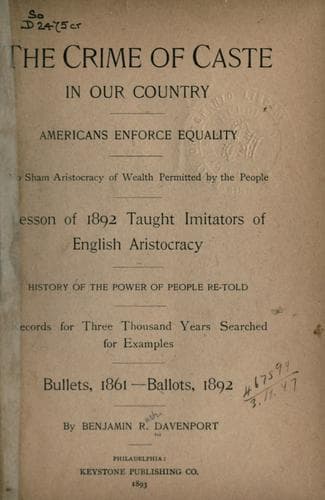
The Crime of Caste in Our CountryDavenport, Benjamin Rush
History
The Crime of Caste in Our Country
Davenport, Benjamin Rush
Social problems; United States -- Social conditions -- 1865-1918
But this accumulation of property in the hands of the few, to the
detriment of the nation, has become so pronounced and overwhelming in
its productiveness of evil that, suppose the people should--for they
could, by means of an income tax--decree that it should cease. Now,
men of a sham and wealthy aristocracy, what would you do about it?
You would be obliged to drink your cup of hemlock, as the striker at
Homestead was obliged to partake of his draught of defeat.
Gentlemen, who assume to be better every other day in the year, but who
realize on election day that your votes are no better, and count for no
more, than the laborer’s, mechanic’s, and the poor man’s all over our
land, what are you going to do about it? It is a condition so pregnant
with possibilities that it should occasion you to take thought. Do not
arouse the resentment of your fellow-citizens; poor they may be, but
rich in their rights as freemen. By the exercise of their franchise
they can make legal that which would demand a division of some of
your ill-gotten gains for the support of the Federal Government, thus
lightening the taxes upon those who can least afford to pay them.
[Illustration: W. SEWARD WEBB,
VICE-PRESIDENT OF THE NEW YORK CENTRAL R. R.]
The poor have learned; the workman has been taught by sad experience;
the laborer has had it forced down his throat, by the point of the
bayonet in the hands of the militiamen, that he cannot hope to
win in the battle against capital by strikes or organized labor.
Homestead, and the wretched condition of the people there, is fraught
with significance, to the laboring man, of the consequences of his
ineffectual battle against capital. He knows that to resort to
violence, mob law, dynamite, is against the spirit of the people of
America. In his heart of hearts his home is as dear to the workman as
yours is to you, Mr. Carnegie. He does not believe in anarchy, and the
dissolution of law, order, and the morals of the people any more than
you do. He doesn’t believe, any more than you do, Mr. Son-in-law Seward
Webb, in the destruction of property. He feels oppressed; he feels
that the burden has been laid too heavily upon his shoulders; he is
irritated at the load he is carrying; no longer will he resort, as the
acme of his hopes, to a strike or a labor organization; he has learned
in the election of 1892 that the power to correct these evils is his;
that on election day, at the polls, he may right these wrongs. Be you
warned, who count your millions, that the bandage which has blinded
the eyes of the poor, making them fight at shadows, has been removed
from their eyes, and that they will make such a vigorous and effectual
onslaught upon your cherished bulwarks of bullion that the equalizing
process may become so rapid and effectual as to demolish your cherished
fortresses of wealth.
Public-domain text, read in full here on John Shaqi.
Reviews
Reviews
No reviews yet
Be the first to share your thoughts on this work.
Elsewhere in the archive
Join the Discussion
Join the discussion
Sign in to leave a comment or review.
Sign InorCreate an account