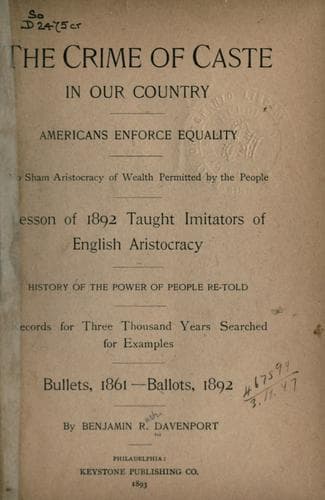
The Crime of Caste in Our CountryDavenport, Benjamin Rush
History
The Crime of Caste in Our Country
Davenport, Benjamin Rush
Social problems; United States -- Social conditions -- 1865-1918
It is not to disorganize society; it is not to overturn religion, or
resort to Nihilism, that the tendency of the workingman’s mind leans.
It is your presumption, arrogance, and overwhelming self-esteem that
has offended him. A baby’s finger may touch the spring holding the bar
by which is caged the lion. The lion once uncaged, and a hundred men
cannot restrain its freedom. A little stream of water, flowing over the
top of a dam, might have been stopped by a handful of mud in the hands
of a child; increasing, the stream weakens the barrier; the dam has
gone, the flood has come.
There’s a little stream of truth trickling over the dam that holds back
the flood of the resentment of the people; silently, softly, with an
appearance of “apathy,” it began to move, until the rich received the
first spray, notifying them of its approach, November the 8th, 1892.
CHAPTER X.
THE CAUSE OF BULLETS, ’61; BALLOTS, ’92.--ABRAHAM LINCOLN, THE PEOPLE’S
CHOICE IN ’60.
Of political parties in America, De Tocqueville declared that
“Aristocratic or democratic passions may easily be detected at
the bottom of all parties, and although they escape a superficial
observation, they are the main point and soul of every faction in the
United States.”
That greatest conflict of American history, the military and political
struggle between the forces of slavery and the forces of human freedom,
was no less a conflict between aristocracy and democracy. In the
South, which President-elect Cleveland only the other day termed--with
undoubted historical accuracy--the cradle of American liberty, there
had been developed a social and political aristocracy as distinct and
powerful as almost any the world has seen.
To this development, which did not become marked until after the early
part of the present century, many causes contributed. The industry of
the South had become centralized in the hands of large land owners
who cultivated extensive plantations with slave labor. The tremendous
growth of slavery exerted a depressing effect upon the manufacturing
spirit; the artisan, the mechanic, and the trader came to be regarded
as socially inferior. The planting of rice, sugar cane, and especially
cotton, which was found to be the most profitable business, was also
the most esteemed; and the South became an almost purely agricultural
section.
Lorin Blodget lays it down as an accepted rule that “the country wholly
devoted to agriculture necessarily tends to aristocratic despotism,
or some form of enslavement of the masses;” and he quotes similar
expressions from Adam Smith, Buckle, and other recognized authorities
on political economy.
Public-domain text, read in full here on John Shaqi.
Reviews
Reviews
No reviews yet
Be the first to share your thoughts on this work.
Elsewhere in the archive
Join the Discussion
Join the discussion
Sign in to leave a comment or review.
Sign InorCreate an account