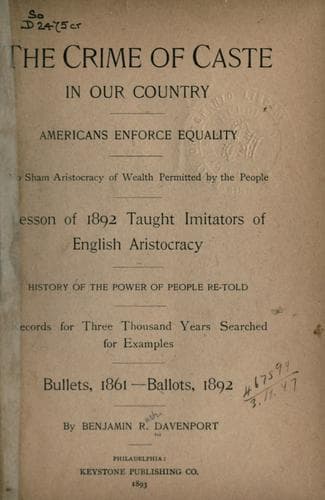
The Crime of Caste in Our CountryDavenport, Benjamin Rush
History
The Crime of Caste in Our Country
Davenport, Benjamin Rush
Social problems; United States -- Social conditions -- 1865-1918
Nor are reasons hard to find. De Tocqueville points out that the great
guarantees of popular liberty in America are universal education and
the general division of landed property. Now, in a purely agricultural
country the education of the people is certain to be defective.
The population is necessarily dispersed, for where there are no
manufactories there can be few towns; and where there are few towns
there are fewer and less efficient schools, and libraries and lyceums
are practically unknown. Harrison’s “History of Virginia” states that
that State had, in 1848, 166,000 youths between seven and sixteen years
old, of whom only 40,000 attended any school.
Landed property had naturally tended to fall more and more into a few
hands. As John Stuart Mill said of ancient Rome: “When inequality
of wealth once commences in a community not constantly engaged in
repairing, by industry, the injuries of fortune, its advances are
gigantic; the great masses swallow up the smaller. The Roman Empire
ultimately became covered with the vast landed possessions of a
comparatively few families, for whose luxury, and still more for
whose ostentation, the most costly products were raised, while the
cultivators of the soil were slaves or small tenants in a nearly
servile condition.” The description is closely applicable to the landed
aristocracy of the South in the years immediately before the war.
It is a mistake--a not uncommon mistake--to suppose that the
_ante-bellum_ South was poor. It was rich--considerably richer than the
North, in proportion to its population. In 1860 the South had much more
than its share of the assessed wealth of the nation. The total value
of property in the Union was $12,000,000,000, and of this the Southern
States, with only one-third of the country’s population (and less than
one-fourth of the country’s _white_ population), had $5,000,000,000, or
more than forty per cent.
But in the agricultural South wealth was far more unevenly distributed
than in the manufacturing and commercial North. In the latter great
fortunes were made, but were almost sure to be distributed among
several heirs, or lost in the fluctuations of trade, while the
prevalence of the industrial and inventive spirit opened the path of
advancement to those born at the bottom of the ladder. In the former,
large landed properties were handed down from father to son, and tended
to grow larger by accretion, as is the rule with great estates. The
small land owner could not compete with them. The peasant, whose only
calling was the tilling of the soil, had little prospect of bettering
his condition.
Public-domain text, read in full here on John Shaqi.
Reviews
Reviews
No reviews yet
Be the first to share your thoughts on this work.
Elsewhere in the archive
Join the Discussion
Join the discussion
Sign in to leave a comment or review.
Sign InorCreate an account