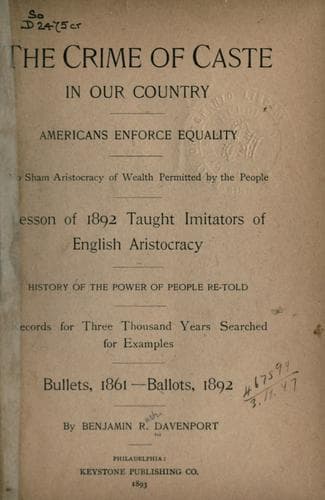
The Crime of Caste in Our CountryDavenport, Benjamin Rush
History
The Crime of Caste in Our Country
Davenport, Benjamin Rush
Social problems; United States -- Social conditions -- 1865-1918
Andrew Jackson represented, in his person, the people, the masses.
By birth, education, and mode of living, Andrew Jackson was
identified with the Common People, and, as we are all common, with
all of the people. Like Abraham Lincoln, the masses saw in Andrew
Jackson a champion, ready and brave enough to resent the attempted
differentiation sought to be foisted upon the people of America by
the then Whig aristocracy--the claimed parent of the Republican
party. However, Abraham Lincoln’s Republican party was not a progeny
of the aristocrats of the Whig party. Andrew Jackson, in his person,
represented the purest type of the western pioneer, patriot, and
soldier, and such men in America will only be found in the ranks of the
people.
In 1828, John Quincy Adams, and his party of the would-be “Four
Hundred,” received at the hands of the people the same punishment and
rebuke that was administered to Benjamin Harrison and the Republican
party, which, just like the Whig party, had become hidden from the view
of the people by the glamour of wealth and would-be aristocracy that
was thrown over it. In Andrew Jackson, the people elected as their
chief one possessed of great firmness and decision of character, one
who was honest and true; not always correct in judgment, but when he
erred the people were ready to forgive him, because the error was one
of judgment and not of intention. He was of them, and like them, as
Abraham Lincoln was in 1860, and the people’s love and trust in him
erased from their memory mistakes that in another would have been
judged with a critical eye. He was often rash in expression and action,
but his very rashness was the rashness of a man untrained in duplicity.
He was not a diplomat. The people are not diplomatic, and he, as one
of them, could not be expected to possess characteristics other than
those of the mass. His actions were as a mirror in which the people saw
themselves. How the chord he struck, when he threatened to hang John
C. Calhoun and the nullifiers, finds a responsive echo in many of the
utterances of Abraham Lincoln! What two men so nearly resemble each
other to the people?
The mere idle calling one a Democrat and the other a Republican is, as
Hamlet says: “Words, words, words.” There is no significance in the
mere word Democrat and Republican. Both were men of the people, elected
as the choice of the masses, in the constant battle that the masses
wage against the crime of “caste.” The similarity in the characters of
Lincoln and Jackson is nowhere more forcibly illustrated than in that
both were patriots of the purest stamp.
Andrew Jackson took up the administration of the government with
fearless energy, feeling confident that he had the unalloyed loyalty
of the people to support him. Let us hope that Grover Cleveland,
with the same fearless courage, will wage war upon those things
objectionable to the people who have placed in his hands the weapons
with which to do battle.
Public-domain text, read in full here on John Shaqi.
Reviews
Reviews
No reviews yet
Be the first to share your thoughts on this work.
Elsewhere in the archive
Join the Discussion
Join the discussion
Sign in to leave a comment or review.
Sign InorCreate an account