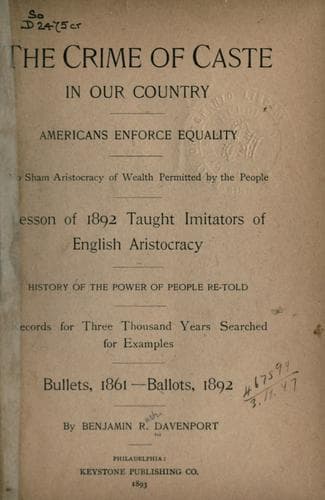
The Crime of Caste in Our CountryDavenport, Benjamin Rush
History
The Crime of Caste in Our Country
Davenport, Benjamin Rush
Social problems; United States -- Social conditions -- 1865-1918
The distinguishing act of Jackson’s first term was his veto of the
bill to re-charter the United States Bank--the boldest defiance that a
President ever cast to the money power of the country. “When President
Jackson attacked the Bank,” De Tocqueville notes, “the country was
excited and parties were formed. The well-informed classes rallied
round the bank, the Common People round the President.” It is a
commonplace of history that, in such cases, the “Common People” are
more often right than those who claim superior information. Jackson’s
veto is regarded by most observers as a remarkable popular victory over
a great capitalistic monopoly.
In none of the six Presidential campaigns between the time of Jackson
and that of Lincoln was the question of popular sovereignty _versus_
class pretensions brought into the contest as an issue, although events
were gradually shaping themselves for the great struggle in which the
period ended. Yet, in 1840, the Democratic personality of General
William Henry Harrison, the Whig candidate, contributed not a little
to his success. The veteran soldier, statesman, and frontiersman had
spent most of his life in a log house beside the Ohio River, at North
Bend, Indiana. A log cabin was chosen by his political followers as
the symbol of his plain and unpretentious way of life, and a barrel of
cider as an emblem of his simple but generous hospitality. During the
“log cabin and hard cider” campaign all over the country, in cities,
villages, and hamlets, log cabins were erected as rallying places for
Harrison’s partisans, who met there to toast their champion in abundant
glasses of cider.
[Illustration: THOMAS JEFFERSON.
The “People’s” President, 1800.]
CHAPTER XII.
THOMAS JEFFERSON, 1800.
In 1800 Adams was a candidate for re-election, and fully expected to
be successful. But the Democratic-Republican party, as the opposition
was now called, defeated him, and elected to the Presidency its great
leader, Thomas Jefferson.
At a glance, it will be seen that the Republican of 1800 was the
father of the Democratic party, the canonized Thomas Jefferson. The
people, even thus early in the history of our nation, had begun to give
evidence of that discontent at the aristocratic tendencies that even
“The Father of his Country,” George Washington, and his successor, John
Adams, displayed.
Public-domain text, read in full here on John Shaqi.
Reviews
Reviews
No reviews yet
Be the first to share your thoughts on this work.
Elsewhere in the archive
Join the Discussion
Join the discussion
Sign in to leave a comment or review.
Sign InorCreate an account