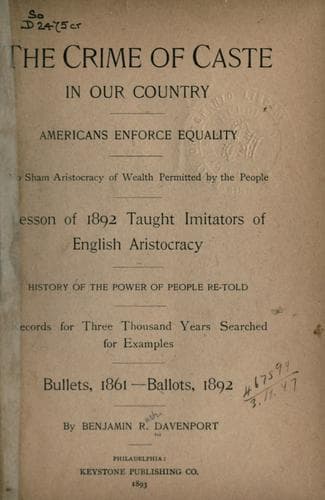
The Crime of Caste in Our CountryDavenport, Benjamin Rush
History
The Crime of Caste in Our Country
Davenport, Benjamin Rush
Social problems; United States -- Social conditions -- 1865-1918
It would be considered almost sacrilege were we to republish here the
many attacks that were made upon George Washington, when President of
the United States, on account of the odor of aristocracy with which
he had become so strongly impregnated before the Revolution, and
which clung to him like the scent of the roses to the shattered vase.
While there can be no doubt, of course, in the minds of us all, that
Washington was pre-eminently a patriot, with a firm and steadfast faith
in the doctrine of the rights of the people; still, he belonged to a
section, to a State, that had been settled by Cavaliers who believed
that they were somewhat better by birth than the Pilgrims of New
England. And, having been born and educated in that atmosphere, it is
small wonder that his character should have been somewhat attainted by
his surroundings.
Upon Washington’s elevation to the Presidential chair he surrounded
the executive mansion with more of the air of ceremony and evidences
of “caste” than were pleasant to the mass of the people. He was
attacked, during his first and second terms, by pamphleteers, who, in
most scurrilous articles, wrote of him as one designing to perpetuate
aristocracy and “caste” in our country. The debt of gratitude which
the new Republic and the people thereof owed Washington was too great
for any effect to be produced similar to the revolution in 1892.
However, an impression was made; reluctantly, John Adams, Washington’s
Vice-President, was elected as second President of the Union. This
reluctance became apparent by his failure to be re-elected four years
later.
A Minister from the United States to England always seems to become a
suspicious object in the minds of the people of America. No man ever
added to his popularity by being sent as Minister to the Court of St.
James. John Adams, who was our first Minister, was but the beginning of
a long list of unfortunates. In fact, the American people will heartily
endorse the opinion of that great statesman, James G. Blaine, which is
being so vigorously advocated by the New York _Herald_, that foreign
Ministers are expensive and useless appendages of this Republic. The
election of John Adams was occasioned more by the reflected glory of
Washington and the gratitude of the people, which, like the rays of
the declining sun, became diminished as it sunk behind the horizon of
time. In Thomas Jefferson, the people, even thus early in the history
of our nation, saw _their_ friend. His simplicity of life, purity of
character, and honesty of purpose, surrounded his name with the same
halo, in the sight of the people, as that with which the names of
Jackson, Lincoln and Cleveland have since been made luminous. Though
Jefferson was called a Republican, still, to the people, he was a
Democrat in the sense that democracy means equality.
Public-domain text, read in full here on John Shaqi.
Reviews
Reviews
No reviews yet
Be the first to share your thoughts on this work.
Elsewhere in the archive
Join the Discussion
Join the discussion
Sign in to leave a comment or review.
Sign InorCreate an account