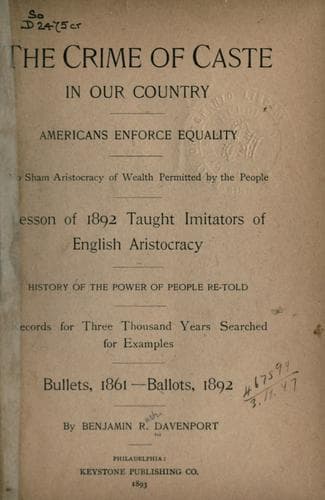
The Crime of Caste in Our CountryDavenport, Benjamin Rush
History
The Crime of Caste in Our Country
Davenport, Benjamin Rush
Social problems; United States -- Social conditions -- 1865-1918
Never was there a statesman more thoroughly imbued with the principles
of popular liberty than Jefferson. “Rebellion to tyrants is obedience
to God”--Oliver Cromwell’s saying--was the motto engraved on his seal.
He had taken a leading part in the colonies’ struggle for freedom.
He was a member of the Continental Congress, Governor of Virginia
during the war, and--a yet greater title to immortality--author of the
Declaration of Independence. After the war he had been sent as American
Minister to France, where he sympathized warmly with the revolution
against Bourbon tyranny.
Jefferson’s election to the Presidency was universally regarded as a
great popular triumph. He was hailed everywhere as “the Man of the
People,” and the day that saw him inaugurated was celebrated with such
rejoicings as had not been witnessed since the news of peace came, in
1783. No business, no labor was done on the 4th of March, 1801. It
was a day of powder and parades, of church services, of bell-ringing,
of speeches, and illuminations. The country’s satisfaction seemed
unanimous.
“The exit of aristocracy” was a toast drunk at one great banquet that
evening; and when it had been duly honored, the band appropriately
struck up the “Rogue’s March.”
The inauguration itself was a simple affair enough. It has, indeed,
been asserted that Jefferson rode up Capitol Hill without a single
attendant, tied his horse to a picket fence, and walked alone into
the Senate chamber to take the oath of office. Professor McMaster
offers evidence to prove this story inaccurate. Jefferson was not
surrounded, on his induction into the Presidency, by such throngs as
attended the inaugurations of Washington and Adams in New York and
Philadelphia. But he went to the Capitol in the midst of a gathering of
citizens, with the accompaniment of drums, flags, cannon, and a troop
of militia. His dress was, as usual, that of a plain citizen, without
any distinctive badge of office. On taking the oath of office he said,
in a brief speech to the Senate: “I know that some honest men fear that
a republican government cannot be strong--that this government is not
strong enough. I believe this, on the contrary, to be the strongest
government on earth.”
Jefferson’s administration--so economical, business-like, and
democratic as to have made “Jeffersonian simplicity” a proverb--met
with such approval that when he was re-elected in 1804 only fourteen
votes were recorded against him. Only in one State--Massachusetts--was
there any excitement in the campaign.
The supremacy of the Democratic-Republican party lasted practically
unchallenged until John Quincy Adams was elected, under peculiar
circumstances, in 1824. There were in that year three leading
candidates for the Presidency--Adams, Clay, and Jackson. As neither
of them commanded a majority of the Electoral College, the question
was referred to the House of Representatives, which selected Adams as
being, in a measure, a compromise candidate.
Public-domain text, read in full here on John Shaqi.
Reviews
Reviews
No reviews yet
Be the first to share your thoughts on this work.
Elsewhere in the archive
Join the Discussion
Join the discussion
Sign in to leave a comment or review.
Sign InorCreate an account