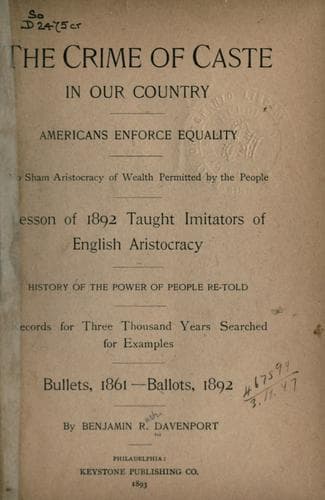
The Crime of Caste in Our CountryDavenport, Benjamin Rush
History
The Crime of Caste in Our Country
Davenport, Benjamin Rush
Social problems; United States -- Social conditions -- 1865-1918
November 8, 1892, showed that the workmen couldn’t be bought, the
farmer couldn’t be bought, the veteran couldn’t be bought, the negro
couldn’t be bought, by all the fair promises held out by the party
of Protection, because this cup of nectar was poisoned by the deadly
essence of “caste,” which means extinction of all that the people
hold dear. Should the Democratic party create, cause, or have arise
under its administration, and become attached to that party, any set,
or “caste,” claiming any superiority over their fellow-citizens, the
Democratic party would be killed, though the eternal sun might never
shine again upon America should that party be defeated.
The purpose and object for which this book is written is not for the
instruction of the people as to how they _are_ to do, but it is, if
possible, to put notes to the music that has been singing in the hearts
of the Common People,--for we are all Common People. That song which
echoes our own sentiments, even though we cannot sing the song, is
always the sweetest. The man who tells the story we have thought and
felt, is the greatest writer to us. Dickens is dear to the hearts of
us all because he echoes and puts in words the sentiments of our own
souls. If this book tell, in words, that which has been throbbing in
the breasts of the people, it but articulates that which they have
spoken silently for themselves. The author is one of the people, but he
has felt what he believes others have felt. The book is not intended
to aid or to harm either the Democratic or the Republican party.
The writer is a supporter of ANY party, call it what you will, that
represents the BEST INTERESTS, THE HONOR, DIGNITY, VIRTUE, of AMERICANS
and American homes.
“Is there, for honest poverty
That hangs his head, and a’ that;
The coward-slave, we pass him by.
We dare be poor, for a’ that;
For a’ that, and a’ that,
Our toil’s obscure, and a’ that,
The rank is but the guinea’s stamp;
The man’s the gowd for a’ that.
“What though on homely fare we dine,
A prince can make a belted knight,
A marquis, duke, and a’ that;
But an honest man’s aboon his might
Guid faith he manna fa’ that,
For a’ that, and a’ that,
The pith o’ sense and pride o’ worth
Are higher ranks than a’ that.
“Then let us pray that come it may,
As come it will for a’ that,
That sense and worth, o’er a’ the earth,
May hear the gree, and a’ that,
That man to man, the world o’er,
Shall brothers be for a’ that.”
[Illustration: GROVER CLEVELAND.
Selected by the “Common People,” November 8, 1892, to Represent the
Interests of the Masses against the Classes.]
FOOTNOTE:
[1] This story has frequently been related, verbally, but the Author
has never seen it in print. Its authenticity, however, is fully
established.
CHAPTER I.
VOX POPULI, VOX DEI.
Public-domain text, read in full here on John Shaqi.
Reviews
Reviews
No reviews yet
Be the first to share your thoughts on this work.
Join the Discussion
Join the discussion
Sign in to leave a comment or review.
Sign InorCreate an account