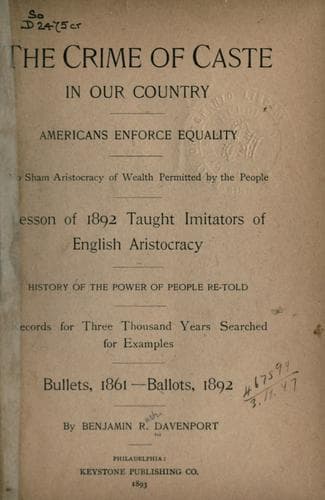
The Crime of Caste in Our CountryDavenport, Benjamin Rush
History
The Crime of Caste in Our Country
Davenport, Benjamin Rush
Social problems; United States -- Social conditions -- 1865-1918
The voice of the people, is indeed, the voice of God, and in grand and
tremendous tones has that voice resounded through the land. The 8th of
November, 1892, will long be remembered in the history of our country
as one which stands in the annals of time as a monument to the might
of the people, upon which might be carved in letters of everlasting
durability, “Do not tread on me.” The tidal wave, so often referred to
by the newspapers, has come with unexpected momentum, washing aside the
puny politicians as thistledown on the mighty stream of the Mississippi.
That mirror of public opinion, so generally correct, so apt to be
accurate, is absolutely stupefied by the tremendous character of the
uprising of the people. Even those who fondly hoped for victory,
among the Democratic journalists, stand in reverential awe before the
stupendous results so noiselessly and irresistibly effected by the
masses. They vainly seek, like one bereft of sight, for the delusive
cause of this great outpouring of Democratic sentiment.
That most preëminent and respectable organ of mugwump principles,
the New York _Times_, of November 9, 1892, sounds the praises of
Cleveland and his popularity as the cause; which is pardonable, as the
_Times_ has consistently closed its eyes before the blinding light of
Cleveland’s preëminence and brilliancy, and refused to see anything
else or any other issue in the campaign, arguing that by the magic of
the one word, “Cleveland,” victory could be attained. Its leader on
the result of the people’s resentment to the crime of “caste” in our
country, is a sounding eulogy upon Cleveland, with here and there a
glimmer of light breaking upon the vision.
“Meanwhile the victory of Mr. Cleveland is the most signal since
the re-election of Lincoln in the last year of the war for the
Union.”
It is noticeable in this paragraph that Cleveland’s preëminence so
overshadowed, in the mind of the _Times_, Lincoln, that the prefix
of “Mr.” is used before Cleveland’s name, while just plain “Lincoln”
is good enough for the man who preserved the Union. One would hardly
expect, therefore, that the _Times_ would do more than shout the
praises of Cleveland, and give no credit to the sense of the people for
their victory. Quoting from their article:--
Public-domain text, read in full here on John Shaqi.
Reviews
Reviews
No reviews yet
Be the first to share your thoughts on this work.
Join the Discussion
Join the discussion
Sign in to leave a comment or review.
Sign InorCreate an account