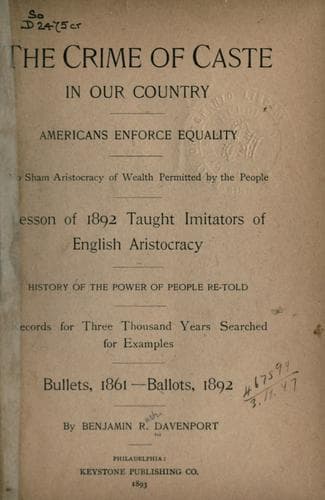
The Crime of Caste in Our CountryDavenport, Benjamin Rush
History
The Crime of Caste in Our Country
Davenport, Benjamin Rush
Social problems; United States -- Social conditions -- 1865-1918
John Quincy Adams was at that time acting with the Democratic party,
but he was, as James Parton points out in his “Life of Jackson,” “a
Federalist by birth, by disposition, by early association, by confirmed
habit.” And it soon became clear that Federalism, long supposed to
be dead, was “living, rampant, and sitting in the seat of power.”
Federalists were appointed to office--notably Rufus King, the most
conspicuous survivor of the original Federalists--who was sent as
minister to England. Adams was for stretching the Constitution, as the
old Federalists were. In his first message to Congress he advocated
government roads and canals, a government university and observatory,
government exploring expeditions, and the like.
His personality and manners revived the aristocratic traditions of his
father. In the state he maintained at Washington he was said to go
beyond the first President Adams. He refurnished the White House on
a grand scale, and shocked the frugal taste of the day by placing a
billiard table in it. The East Room, in which his excellent mother had
hung clothes to dry, was now a luxuriously fitted apartment.
“John II.” was the name that John Randolph of Roanoke bestowed upon
the son and heir of the “Duke of Braintree.” Randolph had hated the
Adams family since an incident that occurred on the day of Washington’s
inauguration, which he recalled long afterwards in one of his speeches.
“I remember,” he said, “the manner in which my brother was spurned by
the coachman of the Vice-President--John Adams--for coming too near the
vice-regal carriage.”
Even Mr. Blaine, who in his “Twenty Years of Congress” shows himself a
kindly critic of the Federalist ideas and Federalist leaders, admits
the “general unpopularity attached to the name of Adams.”
During John Quincy Adams’ administration the mutterings of a coming
political upheaval began to be heard. It began to be said that the
Presidency was growing too much like an hereditary monarchy. It was
becoming too settled a practice for each incumbent, after eight years
in office, to make his Secretary of State his political heir. It gave
the President what was almost equivalent to the power of appointing his
successor. John Quincy Adams, it was said, counted confidently on the
usual double term, and upon seeing his friend Clay, to whom he had
given the chief post in his Cabinet, elected to succeed him.
Public-domain text, read in full here on John Shaqi.
Reviews
Reviews
No reviews yet
Be the first to share your thoughts on this work.
Elsewhere in the archive
Join the Discussion
Join the discussion
Sign in to leave a comment or review.
Sign InorCreate an account