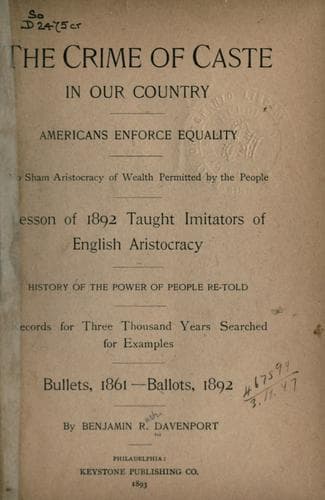
The Crime of Caste in Our CountryDavenport, Benjamin Rush
History
The Crime of Caste in Our Country
Davenport, Benjamin Rush
Social problems; United States -- Social conditions -- 1865-1918
“The issue is fairly made out: Shall the government or the people
rule?” asked Andrew Jackson, and on that issue he appealed to the
country in his memorable electoral campaign against Adams, in 1828.
That was the bitterest Presidential contest that had ever been fought.
Jackson was attacked with unexampled ferocity. One day at his Tennessee
home, the Hermitage, his wife found him in tears. “Myself I can
defend,” he said, pointing to a newspaper which he had been reading;
“you I can defend; but now they have assailed even the memory of my
mother.” And it was, in great part, her distress at the invective that
was heaped upon her husband that caused the death of Mrs. Jackson just
after the election.
It was a pitched battle between the “classes” and the “masses.” As
James Parton says, in his biography of Jackson: “Nearly all the talent,
nearly all the learning, nearly all the ancient wealth, nearly all the
business activity, nearly all the book-nourished intelligence, nearly
all the silver-forked civilization of the country, united in opposition
to General Jackson, who represented the country’s untutored instincts.”
CHAPTER XIII.
THE REVOLUTION IN 1776.
Revolt from aristocracy and detestation of “caste” in politics, in
religion, and in society, have been the key-notes of the whole history
of the Anglo-Saxon race in America. They were the incentives that first
led men of that race to seek homes beyond the Atlantic, and have ever
been the cardinal principles of the nation those pioneers founded.
The westward movement began with that era of English history marked by
the intolerable pretensions, in matters both of Church and State, of
the Stuart monarchs. The doctrine of the “divine right of kings,” which
cost Charles I. his head, was, with all that it meant, the grievance
that drove from England the settlers of the American colonies.
When James I., soon after his accession, was petitioned to allow
liberty of assembling and of discussion to all classes and sects of his
subjects, he replied that such a privilege “agrees with monarchy as
well as God and the devil. Then Jack and Tom and Will and Dick shall
meet, and at their pleasure censure me and my council and all our
proceedings. Then Will shall stand up and say: ‘It must be thus;’ then
Dick shall reply and say: ‘Nay, marry, but we will have it thus;’ and,
therefore, here I must say: ‘The king forbids.’”
The king forbade, but the native spirit of English liberty did not
acquiesce without a murmur. There were mutterings of the storm that
was to burst upon his son and successor in the full fury of rebellion.
The subservient Wentworth complained that “the very genius of this
nation of people leads them always to oppose, both civilly and
ecclesiastically, all that ever authority ordains for them.”
Public-domain text, read in full here on John Shaqi.
Reviews
Reviews
No reviews yet
Be the first to share your thoughts on this work.
Elsewhere in the archive
Join the Discussion
Join the discussion
Sign in to leave a comment or review.
Sign InorCreate an account