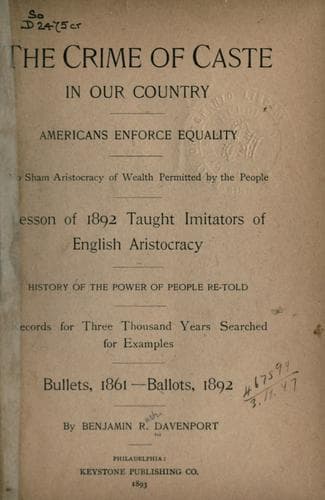
The Crime of Caste in Our CountryDavenport, Benjamin Rush
History
The Crime of Caste in Our Country
Davenport, Benjamin Rush
Social problems; United States -- Social conditions -- 1865-1918
Most outspoken in opposition to royal encroachment were the
Puritans--those stern disciples of Calvin, who had furnished England
her first Protestant martyrs, Hooper and Rogers, and who, in the early
seventeenth century, were, as Hallam says, “the depositories of the
sacred fire of liberty.”
Many Puritans preferred to leave their native country rather than
submit. In 1607, a company of them were about to take sail for Holland
from the Humber, when they were arrested and forced to return to their
homes. In the following spring, they again attempted to escape. They
reached the Lincolnshire coast, and were embarking, when soldiers, who
had been dispatched in pursuit, rode down to the shore, and seized some
of the women and children. As the only fault of these prisoners was
that they had followed their husbands and fathers, they were afterward
released.
The fugitives, whose leaders were John Robinson, their minister, and
William Brewster, their ruling elder, first tarried at Amsterdam, and
the next year settled at Leyden. There they lived for eleven years--a
body of exiles, who did not fraternize with their Dutch neighbors, and
who gradually formed a plan of migrating to the new country beyond the
Atlantic, where they might be under their old flag, and yet hope for
civil and religious liberty.
In 1617, they sent two of their number to England, to secure for their
project the consent of the London Company, to which James I. had
granted proprietary rights over Virginia--then the general name of the
North American coast. The two embassies received a permit, although
they put no great trust in it. “If,” said they, “there should afterward
be a purpose to wrong us, though we had a seal as broad as the house
floor, there would be means enough found to recall or reverse.” They
did not foresee their future strength against oppression.
Thus it was that in the August of 1620 the Pilgrims set sail from Delft
Haven, and in November landed on the shores of Massachusetts--forty-one
families, numbering in all a hundred and two souls. Before they
landed, they signed a mutual agreement, covenanting “to enact,
constitute, and frame such just and equal laws as shall be thought
most convenient for the general good of the colony.” The agreement
was loyally kept in the face of hardship and danger from within and
without. The colony they planted grew in the spirit of popular liberty
as it grew from penury to prosperity.
Bancroft remarks that “in the early history of the United States,
popular assemblies burst everywhere into life, with a consciousness of
their importance and immediate efficiency.” This development of freedom
was attained in Virginia even earlier than in Massachusetts.
Public-domain text, read in full here on John Shaqi.
Reviews
Reviews
No reviews yet
Be the first to share your thoughts on this work.
Elsewhere in the archive
Join the Discussion
Join the discussion
Sign in to leave a comment or review.
Sign InorCreate an account