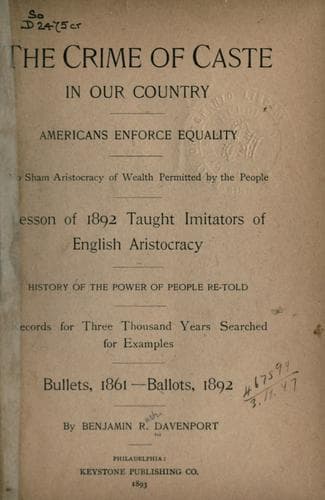
The Crime of Caste in Our CountryDavenport, Benjamin Rush
History
The Crime of Caste in Our Country
Davenport, Benjamin Rush
Social problems; United States -- Social conditions -- 1865-1918
Virginia’s first struggle against usurping pretension was in 1624,
when James I. sent out royal commissioners with orders “to enquire
into the state of the plantation.” The colonists protested against the
commissioners’ proposal of absolute governors, and demanded the liberty
of their Assembly; “for nothing,” they said, “can conduce more to the
public satisfaction and public utility.” And the Assembly succeeded in
retaining its rights.
Thirty years later, a domestic attempt at usurpation was met with equal
firmness. Samuel Cotton, the elected governor of the colony, had a
quarrel with the Assembly, and arbitrarily proclaimed it dissolved.
The representative defied his authority, and speedily forced him to
yield. For even in that colony in America, where existed more of the
inclination to class distinction than in many other of the colonies,
the same spirit of hatred to “caste,” and the exercise of any assumed
superiority was deep-rooted, and thus early gave evidence of its
presence.
At the foundation of Virginia’s sister colony of Maryland, the king
expressly covenanted that neither he nor his successors would lay any
imposition, custom, or tax upon the inhabitants of the province. The
proprietors had the right to establish a colonial aristocracy, but
it was never exercised. “Feudal institutions,” says Bancroft, “could
not be perpetuated in the lands of their origin, far less renew their
youth in America. Sooner might the oldest oaks in Windsor forest be
transplanted across the Atlantic, than antiquated social forms. The
seeds of popular liberty, contained in the charter, would find in the
New World the soil best suited to quicken them.” One of the early acts
of the Provincial Assembly of Maryland was the framing of a declaration
of rights. And yet, it was in Baltimore, the metropolis of the State
of Maryland, that the first resistance was offered to the soldiers of
the people, who were going to enforce the will of the majority upon the
minority. Maryland, while, from proximity to the Federal capital, was
less inclined toward the secession movement, was still sufficiently
influenced by the aristocratic slave-holding part of her population
as to be the scene of the first actual resistance to the will of the
people in 1861.
The same spirit animated the pioneers of Connecticut, where Hooker
declared that “the foundation of authority is laid in the free consent
of the people.” When John Clark and William Coddington founded the
settlement of Newport, it was “unanimously agreed upon” among their
people that the body politic should be “a _Democracie_ or popular
government.” The colonization of Pennsylvania--“the holy experiment,”
as Penn called it--was inaugurated by its great leader with a solemn
pledge of “liberty of conscience and civil freedom.” And similar
incidents accompanied the birth of nearly every new colony.
Public-domain text, read in full here on John Shaqi.
Reviews
Reviews
No reviews yet
Be the first to share your thoughts on this work.
Elsewhere in the archive
Join the Discussion
Join the discussion
Sign in to leave a comment or review.
Sign InorCreate an account