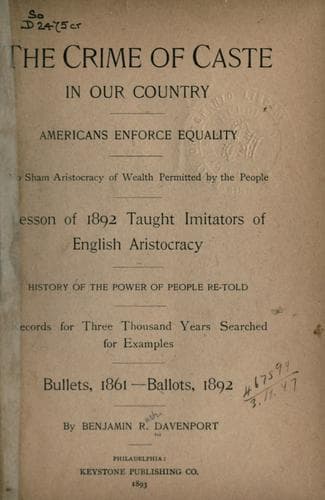
The Crime of Caste in Our CountryDavenport, Benjamin Rush
History
The Crime of Caste in Our Country
Davenport, Benjamin Rush
Social problems; United States -- Social conditions -- 1865-1918
As Massachusetts grew to be the most prosperous of the northern
colonies, she “echoed the voice of Virginia like deep calling unto
deep. The State was filled with the hum of village politicians; the
freemen of every town on the Bay were busily inquiring into their
liberties and privileges.” [Bancroft.] The American spirit, which was
to leaven the world with a new ideal of liberty, found its philosophers
and statesmen in the farms and hamlets of the young and simple
community. It found, of course, its critics and its doubters. Lechford,
a Boston lawyer, prophesied that “elections cannot be safe long here,”
where manhood suffrage was the rule. John Cotton spoke against the
accepted principle of rotation in office; but neither could stem the
current of democratic doctrine, because the early settlers of America
still retained the scars of their recent conflict with the aristocrats
of Europe. Their arrival in the then wilderness of America had been too
recent to obliterate the impression made on their minds by “caste” in
Europe.
In 1635, there was a short-lived possibility that the aristocratic
system of Britain might be transplanted to Massachusetts. Henry Vane,
younger son of a titled English family, emigrated to the colony, where
he was kindly received, and elected governor a few years after; and two
noblemen, Lord Brooke and Lord Say-and-Seal, expressed their intention
to follow him if the colonists would agree to establish a second
chamber of their legislature and constitute them hereditary members of
it. But the burgesses, easily perceiving the trend of such a proposal,
declined it, courteously but decidedly.
Aristocracy never found a foothold in any of the colonies. The only
approach to it was the privileges accorded in some of them to the
“proprietors,” and these were, while they lasted, regarded with some
jealousy. For instance, when Pennsylvania, after Braddock’s defeat at
Fort Duquesne, decided to raise £50,000 for self-defence by an estate
tax, the proprietors--heirs of William Penn--claimed exemption from
the levy; but, though Governor Morris approved the claim, the Assembly
refused it.
Bancroft thus characterizes the elemental beginnings of the American
nation: “Nothing came from Europe but a free people. The people,
separating itself from all other elements of previous civilization;
the people, self-confident and industrious; the people, wise by all
traditions that favored its culture and happiness--alone broke away
from European influence, and in the New World laid the foundations
of our Republic.” And periodically, as we see from the records of
our nation, the might of the majority has been exercised to suppress
anything like the attempted institution of “caste” in our country. This
often-recurring crime begins to upraise its head, slowly at first,
after each defeat, but eventually its growth becomes sufficiently great
to attract the attention of the “Common People,” and, as a result,
receives its punishment, so justly due.
Public-domain text, read in full here on John Shaqi.
Reviews
Reviews
No reviews yet
Be the first to share your thoughts on this work.
Elsewhere in the archive
Join the Discussion
Join the discussion
Sign in to leave a comment or review.
Sign InorCreate an account