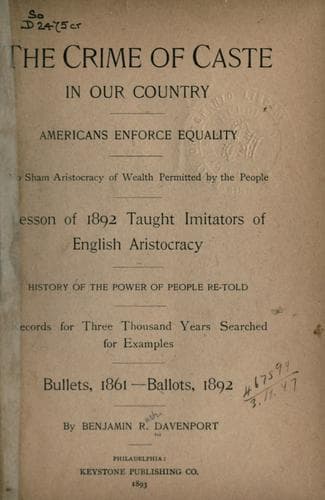
The Crime of Caste in Our CountryDavenport, Benjamin Rush
History
The Crime of Caste in Our Country
Davenport, Benjamin Rush
Social problems; United States -- Social conditions -- 1865-1918
And the same historian adds: “Of the nations of Europe, the chief
emigration was from that Germanic race most famed for the love of
personal independence. The immense majority of American families were
not of ‘the high folk of Normandie,’ but were of ‘the low men,’ who
were Saxons. This is true of New England; it is true of the South.”
It is true of the South, in spite of the fact--influential throughout
the history of that section--that its population contained an element
drawn from the wealthier classes of the mother country. It has indeed
been said that Virginia was “a continuation of English society.”
The seeds of privilege may have existed in the Old Dominion, but,
nevertheless, in no colony was the spirit of personal independence
more signally evinced. “With consistent firmness of character,” to
quote again from Bancroft, “the Virginians welcomed representative
assemblies; displaced an unpopular governor; rebelled against the
politics of the Stuarts; and, uneasy at the royalist principles that
prevailed in their forming aristocracy, soon manifested the tendency of
the age at the polls.”
With the aims of the English rebellion against Charles I., the American
colonies were in full sympathy. Immediately after its outbreak, the
general court of Massachusetts directed the governor to omit the oath
of allegiance to the king, “seeing that he had violated the privileges
of Parliament.” But the civil war had no effect upon the colonial
governments. In England, the monarchy, the peerage, and the prelacy
were at swords’ points with the people; in America, there was neither
peerage nor prelacy, and monarchy was rendered remote by the Atlantic,
so that there were no two parties to join battle.
The Restoration opened a new era in the history of the colonies--a
period of conflict between royal usurpation and aristocratic oppression
on the one hand, and popular liberties on the other; a period that,
after many years of difficulty and struggle, culminated in events that
gave rationality and independence to the greatest democracy the world
has ever seen.
It was a period marked in England by the political ascendency of the
aristocracy. At the Restoration, the nobility resumed possession of
the hereditary branch of the Parliament. Through their influence
over elections, they, to a great extent, controlled the House of
Commons--and through it the crown, over which the Commons had given
recent and striking proofs of power. It was the aristocratic element
that dictated the policy which goaded the colonies into secession from
the mother country. It supplied the office-holders--“carpet-baggers”
they might have been termed in modern political slang--whom the home
government quartered upon the colonials by an official system tainted
with nepotism and corruption. Its foe--Pitt, the great Commoner--was
the friend of America, and one of her few champions in Parliament.
Public-domain text, read in full here on John Shaqi.
Reviews
Reviews
No reviews yet
Be the first to share your thoughts on this work.
Elsewhere in the archive
Join the Discussion
Join the discussion
Sign in to leave a comment or review.
Sign InorCreate an account