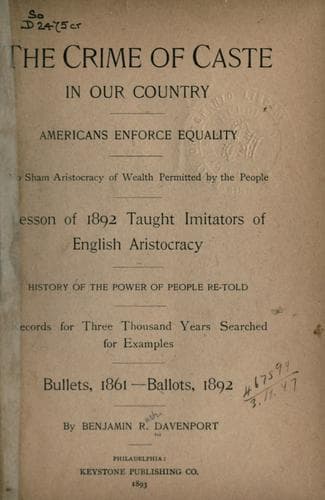
The Crime of Caste in Our CountryDavenport, Benjamin Rush
History
The Crime of Caste in Our Country
Davenport, Benjamin Rush
Social problems; United States -- Social conditions -- 1865-1918
Equally the friend of America was the English democracy--politically
far less powerful during the century after the Restoration than in the
preceding and the subsequent periods. When the hated Stamp Act was
repealed, the “Common People” of London lit bonfires and illuminated
the streets, rang the historic Bow Bells, and decked the shipping in
the Thames with flags.
But the House of Commons, before whom came the critical measures of
legislation for the colonies, reflected the feeling of the aristocracy
and not that of the populace. “The majority,” said a member, during
a debate on American affairs in 1770, “is no better than an ignorant
multitude.” Sir George Saville, a man of rare independence and
integrity, replied in strong words. “The greatest evil that can befall
this nation,” he declared, “is the invasion of the people’s rights by
the authority of this house. I do not say that the members have sold
the rights of their constituents; but I do say, I have said, and I
shall always say, that they have betrayed them.” But his protest was
shouted down as treason, and Parliament blindly pursued its course of
usurpation.
Long before that time, there had been in America thoughts of
independence as a refuge from usurpation. The colonists cherished a
genuine loyalty to the old flag, and a strong pride in the Saxon
blood, whose latest and, indeed, most typical product they themselves
were. Yet, as far back as 1638, when Charles I. tried to revoke
the original patent of Massachusetts, the settlers threatened to
“confederate themselves under a new government for their necessary
safety and subsistence.”
In 1698, Governor Nicholson, of Virginia, reported that “a great many
in the plantations think that no law of England ought to be in force
and binding upon them without their own consent.” Three years later, a
public document noted that “the independence the colonies thirst after
is now notorious.”
The sentiment grew gradually during the reigns of the Georges, slowly
overcoming the strength of the old attachment to the mother country.
Every encroachment attempted by royalty or officialism aroused a
hostility that reinforced the spirit of liberty. For instance, when
Samuel Shute, Governor of Massachusetts in 1719, tried to prevent the
publication of the Assembly’s answer to one of his speeches, claiming
power over the press as his prerogative, he only succeeded in evoking a
vigorous resistance, that finally disposed of his pretension, and gave
the press untrammeled freedom.
And thus it was that a generation later the patriotic Otis, of Boston,
the man “who dared to love his country and be poor,” spoke so boldly
in reply to Hutchinson, who summed up his aristocratic preferences in
the odious Horatian maxim, _Odi profanum vulgus_, and who avowed his
dissatisfaction that “liberty and property should be enjoyed by the
vulgar.”
Public-domain text, read in full here on John Shaqi.
Reviews
Reviews
No reviews yet
Be the first to share your thoughts on this work.
Elsewhere in the archive
Join the Discussion
Join the discussion
Sign in to leave a comment or review.
Sign InorCreate an account