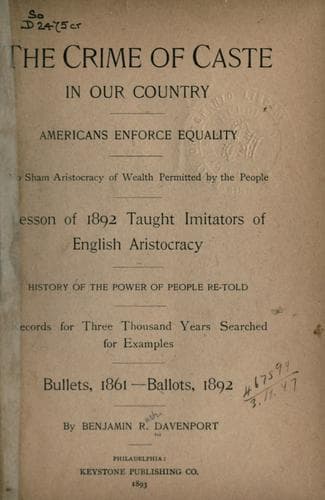
The Crime of Caste in Our CountryDavenport, Benjamin Rush
History
The Crime of Caste in Our Country
Davenport, Benjamin Rush
Social problems; United States -- Social conditions -- 1865-1918
“God made all men naturally equal,” said Otis. “The ideas of earthly
grandeur are acquired, not innate. No government has a right to make
a slave of the subject.” And again, “to bring the powers of all into
the hands of one or some few, and to make them hereditary, is the
interested work of the weak and wicked.”
Such was the philosophy that was daily preached among the burghers of
Boston. Such was the doctrine that Patrick Henry came from the Virginia
backwoods to voice with his burning eloquence. Such was the spirit that
was everywhere animating the colonies, while Parliament enacted one
unjust and oppressive law after another. “The sun of American liberty
has set,” Ben Franklin wrote from Europe to a friend in America, when
he heard of the enactment of the ill-fated Stamp Act; “now we must
light the torches of industry and economy.” “Be assured that we shall
light torches of another sort,” replied his friend.
The torches were lit; they blazed forth in the shots fired at
Lexington, and on Bunker Hill, and in the Declaration of Independence,
at Philadelphia; and they were not put out until Parliamentary
oppression had been forever ended, and a new nation--a plebeian
democracy--took its place by the side of the proudest of earth’s
empires.
The war was fought and won by the “Common People,” in the face of the
armed force of the foreigner, and the treachery, active or passive,
of not a few colonists, whose aristocratic connections or pretensions
held them aloof from the movement for liberty. Even in the darkest
days of the struggle, when Washington, driven from New York, was
retreating before Howe’s advance, and many men of prominence were
giving up the patriotic cause as hopeless--Joseph Galloway and Andrew
Allen, of Pennsylvania, Samuel Tucker, of New Jersey, John Dickinson,
of Delaware, and others--even then the Commander’s wonderful faith and
courage was reflected in the fidelity of the populace. That alone made
possible the final triumph.
Public-domain text, read in full here on John Shaqi.
Reviews
Reviews
No reviews yet
Be the first to share your thoughts on this work.
Elsewhere in the archive
Join the Discussion
Join the discussion
Sign in to leave a comment or review.
Sign InorCreate an account