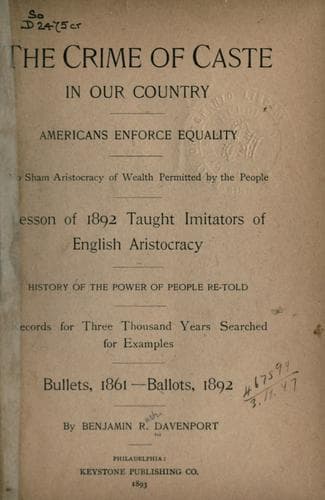
The Crime of Caste in Our CountryDavenport, Benjamin Rush
History
The Crime of Caste in Our Country
Davenport, Benjamin Rush
Social problems; United States -- Social conditions -- 1865-1918
“When the war of independence was terminated,” remarks DeTocqueville,
in his famous study of “Democracy in America,” “and the foundations
of the new government were to be laid down, the nation was divided
between two opinions--two opinions which are as old as the world, and
which are perpetually to be met with under different forms and various
names, in all free communities--the one tending to limit, the other to
extend, indefinitely, the power of the people. The conflict between
these two opinions never assumed that degree of violence in America
which it has frequently displayed elsewhere. Both parties were agreed
on the most essential points, and neither of them had to destroy an
old constitution, or to overthrow the structure of society, in order
to triumph. In neither of them, consequently, were a great number of
private interests affected by success or defeat; but moral principles
of a high order, such as the love of equality and of independence,
were concerned in the struggle, and these sufficed to kindle violent
passions.”
The party that sought to limit the power of the people was that of
the Federalists; its opponents took the name of Republican, which
afterwards became Democratic-Republican, and finally, under Andrew
Jackson, Democratic. In view of the fixed bent of the American national
character, it is not difficult to discern the inevitable result of the
conflict between them. The Federalists were certain to be ultimately
overcome. America is the land of democracy, and the anti-democratic
partisans were always in a minority.
Thus for the brief period succeeding the Civil War, while the wounds
of the conflict were still fresh upon the body politic, the party of
the aristocracy--for such had the Republican party become--utilizing
the soreness still existing as the result of the conflict, succeeded,
by the clamor of sectionalism, in diverting the attention of the masses
from the tendency towards social superiority and “caste,” which the
continuance of the Republican party in power was creating.
This brief ascendency during the first twelve years of the republic
was due to several temporary causes. Most of the great leaders of the
war for independence believed in a strong, centralized government,
and therefore ranked themselves with the Federalists. The failure of
the first attempt at federal control--the Continental Congress--and
the local disorders that arose after the war, had inspired the people
with a dread of anarchy. They were willing to accept, for a time,
restrictive political theories, which it soon became safe to throw off.
The Federalist leaders were more than suspected of aristocratic
tendencies. Elbridge Gerry, of Massachusetts, declared in the
Constitutional Convention of 1787, that “the ills of the country come
from an excess of democracy. The people do not want virtue,” he added,
as if in apology, “but are the dupes of pretended patriots.”
Public-domain text, read in full here on John Shaqi.
Reviews
Reviews
No reviews yet
Be the first to share your thoughts on this work.
Elsewhere in the archive
Join the Discussion
Join the discussion
Sign in to leave a comment or review.
Sign InorCreate an account